
Industry insightPublished: · By MorZan
Motor Cable Length and VFDs: When You Need a dv/dt or Sine Filter
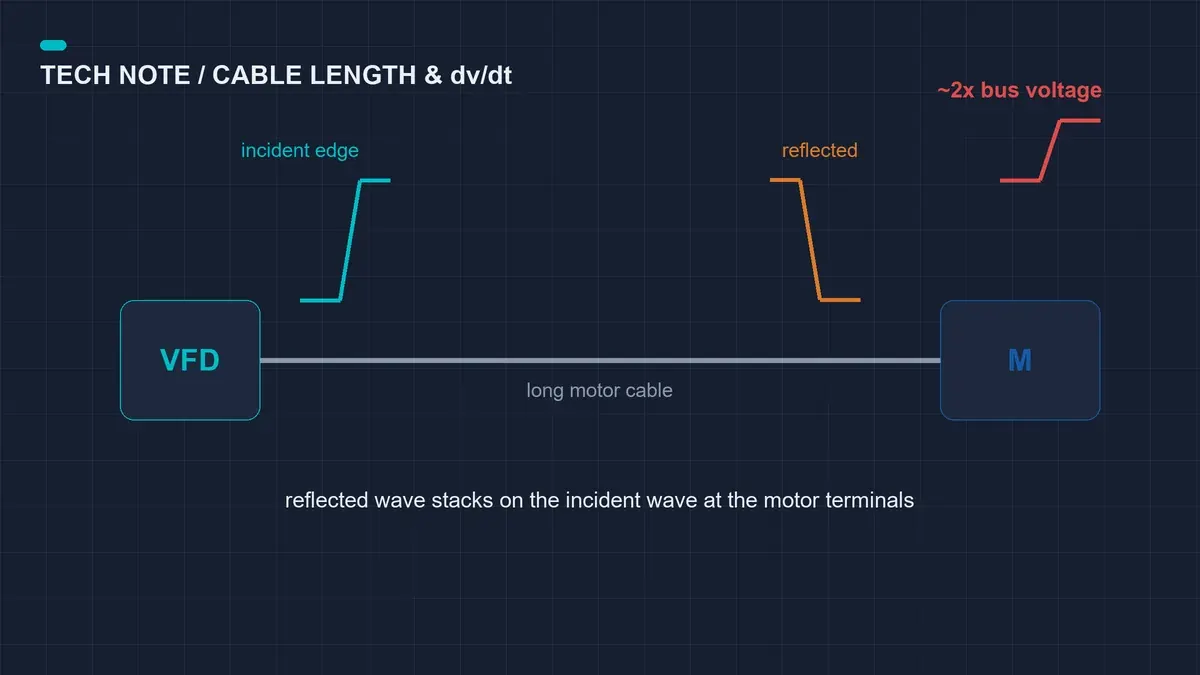
Fast IGBT switching sends a steep voltage edge down the motor cable. If the cable is long enough for that edge to reach the motor, reflect and travel back before the next switching transition, the reflected wave stacks on the incident wave. The motor terminals can then see close to twice the DC bus voltage — roughly 1,000 V peak on a 400 V drive whose bus sits near 540 V. Most insulation systems tolerate that occasionally; none tolerate it for years across every switching cycle.
Three variables set the risk. Cable length is the dominant one: below roughly 20 to 30 metres of unshielded cable, a standard motor is normally comfortable. Switching frequency is the second: a drive set high for quiet operation produces more edges and more reflections per second, so a marginal installation becomes a failure. Motor insulation class is the third, and it matters most on rewound or older motors whose enamel is no longer new.
The remedies rise in cost. Lowering the switching frequency is free but may make the motor audibly noisier. A dv/dt filter at the drive output slows the voltage edge and typically cuts peak overvoltage substantially. A sine filter reconstructs a near-sinusoidal output and permits very long cable runs or the reuse of old motors, at the cost of a larger, heavier and pricier unit. Whichever you choose, use shielded motor cable with correctly bonded PE and keep the three phases symmetrical — those are free and they matter at every cable length.
VFD Applications
Every variable frequency drive (VFD) application is different, because every load behaves differently. These guides explain the drive features that matter for your industry and link to the recommended product range.
All industry guides