
Industry insightPublished: · By MorZan
VFD Screw Compressor Retrofit in an Injection Moulding Plant, From First Call to Meter Reading
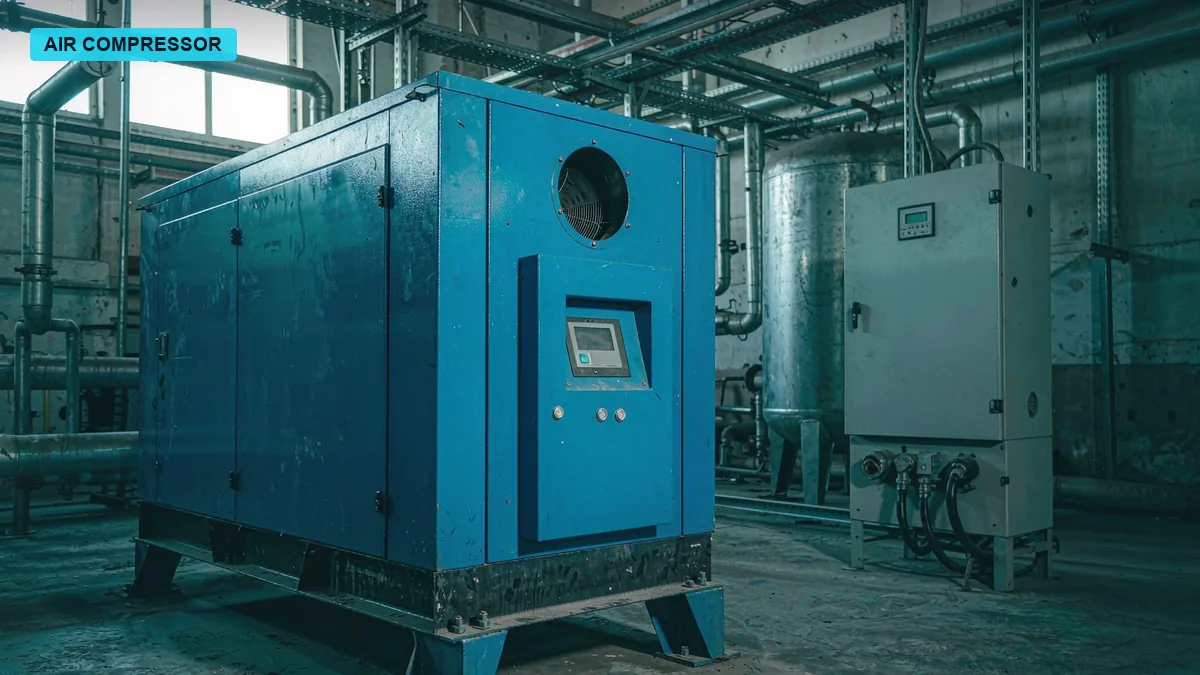
A call about a VFD screw compressor retrofit, and whether it was worth the money
The call came at the end of September, close to five in the afternoon.
The plant makes injection moulded parts. The maintenance manager introduced himself as Wang. He did not ask what a drive costs. His first sentence was that the workshop electricity bill had come in 8,000 yuan higher that month, and that the owner wanted to know whether the compressor was to blame.
I get a dozen calls like that a year. Most of the time the compressor is not the problem. Production has gone up, or there is a leak somewhere nobody has walked the line to find. So I did not give him an answer on the phone. I asked three things. How many machines, what size, and whether the controller kept a run log.
Three, he said. One at 75 kW, two at 37. The log was there.
I said I would drive over.
After I hung up I wrote one line in my notebook. If the compressor really was the problem, the fix was probably not a repair. It was a retrofit.
First visit, can this fixed-speed screw compressor be converted to a VFD at all
I left at half past seven the next morning and drove two and a half hours.
The plant sits in an old industrial zone on the edge of the city. The yard is concrete, patched in places, and it had rained, so two puddles were still standing by the gate. The guard asked me to sign in and who I had come to see. I said Mr Wang. He made a call, then raised the barrier.
Wang was waiting at the workshop door, blue overalls, oil on his hands. He took me to see the electricity bills first, a stack of A4 sheets with three figures circled in pen. Then he walked me to the compressor room.
The room was partitioned off on its own. When the door opened the heat hit my face. Three machines inside. The 75 kW screw sat at the far end, with an inspection tag from the year before last still stuck on the cabinet door, its corner curled up.
The two smaller ones stood beside it. One was running. One was off. There was a patch of oil on the floor, not large, but not new either.
Wang gave me the history in one sentence I have heard many times. It has always been used like this, and it has never given us any trouble.
He was right. A fixed-speed machine does not break down. It just costs more to run.
I did not open the electrical cabinet straight away. I walked a full circle around the machine first. Two vertical receivers, about two cubic metres between them, which is small for the displacement of this unit. The pipework was old galvanised steel. A few joints had a slight oil film, but when I wiped one with my finger it came away dry, so nothing was leaking fresh.
Those details mattered later.
Injection moulding air demand pushed the load factor down to 45 percent
An injection moulding shop has its own rhythm of air demand. The mould closes, the screw shoots, the pack pressure holds, the mould opens. Every one of those steps uses air. The ejection stroke at the end is the heaviest draw, and the pneumatic valves on the mould temperature controllers move with it. All of that happens on the day shift. At night only two or three machines keep running and demand drops off a cliff.
That is what makes a compressor in a plant like this so expensive. It was sized for the day shift peak, and at night it keeps loading and unloading in exactly the same way. It idles all night and nobody thinks anything of it.
Back at the machine I opened the controller menu and paged to the run record.
Two numbers on the screen. 41,200 running hours, 18,600 loaded hours.
I did the division on my phone. Forty-five percent.
Wang leaned in and asked what the number meant.
I said it means that for more than half the time this machine is turning, it is not making air. It fills the receiver, the inlet valve shuts, and the motor keeps spinning while it waits for the pressure to fall. You have been paying for that.
He was quiet for a second. So it is idling, he said.
I said idling draws nothing. This draws. The current is roughly thirty percent of full load.
The room was loud and he did not answer for a few seconds. I could see him working through it. Then he asked how much could be saved.
I said hold on, I need to confirm a few things first.
That was not politeness. A load factor of 45 percent only says there is room. Whether the machine can be converted depends on the condition of the airend, the motor, and the control scheme. Some machines look convertible and turn out not to be worth it.
Where the load factor line falls, three bands
Over the years I have boiled the screening down to three bands.
Above 80 percent loaded
Leave it alone. It is already working at full output, there is no idle time to recover, and the payback would be so long I could not defend it to an owner.
Between 60 and 80 percent
It can be done, but the numbers depend on the electricity price and on how much the load swings. Where the swing is wide, the return sits near the top of the range.
Below 60 percent
Worth calculating properly. This one at 45 percent was one of the better cases I had seen all year.
The three things that rule a machine out
There are also three reasons to walk away. An airend with heavy wear, or a machine close to a major overhaul, is not worth converting. Where three or more compressors run in parallel, converting all of them is usually the wrong spend, and one variable-speed unit with a sequencer works out cheaper. And where the supply is weak and harmonics are already a problem, that has to be assessed before anything is quoted.
This machine passed all three. The airend had been serviced, the oil report was reasonably clean, the motor was a standard induction machine, and the starter was star-delta.
At noon Wang kept me for lunch. The canteen sits behind the workshop. Two dishes and a soup, rice from the pot. He barely ate. He kept asking how many days of production the retrofit would cost him. I said two at most, and we would take a weekend. He nodded and said good, the month end push was coming and he could not afford to stop.
Three machines did not all need a VFD conversion, system layout beat single unit
After lunch, back in the compressor room, he told me what he had in mind. Convert all three. The owner had released a budget and he thought doing it in one go would save trouble.
I gave him the opposite calculation. With three machines in parallel, only one needs to modulate. The other two are steadiest running as base load. Converting all three more than doubles the spend and adds less than thirty percent to the saving.
He frowned. That would be hard to explain upstairs.
I said tell him it costs less and does about the same. He laughed.
This is the most common misjudgement in air compressor VFD conversion work. The goal is not to make every machine variable speed. The goal is to make the compressor room's air supply follow the plant's air demand. How the system is arranged matters more than whether any single machine is converted.
We settled on the 75 kW unit modulating, the two smaller ones left at fixed speed, and a sequencer to decide which machine runs.
The sequencer is not optional in a case like this. If the three machines each work to their own pressure setting, the variable-speed unit grabs load continuously and the saving disappears.
How long does a compressor retrofit take, the first thing a buyer asks
With the scope agreed, Wang did not ask about the price. He asked about the shutdown.
He had asked the same question at lunch. Two days at most, I had said, and we would take a weekend. He let out a breath and said the month end push was coming, he could not stop. I thought that was settled. Then I got back to the office to run the numbers and he asked again on the phone, could it be done in one day.
I said one day was not enough, but I did not just repeat two. I broke the work down for him.
Half a day to strip the old cabinet and trace the wiring. A day to mount the new cabinet, terminate the cables and modify the control circuit. A day for the loaded test, setting the pressure band, the minimum speed and the skip frequency. And that was if everything went well.
He was quiet for a moment. Two days then, Saturday and Sunday.
I said Saturday and Sunday works, but I am keeping a day in reserve on my side. He asked why. I said this machine is not young, the cabinet has been modified by somebody with no record left behind, and the drawing is only a reference. If we open it and find a wire missing, the extra time does not come back.
He laughed and said, you are a straight one.
He was right, as it turned out. Tracing the circuit cost an extra hour on the first day, we were still chasing resonance on the morning of the third, and the job took two and a half days. On schedule, it is better to quote an ugly number than to leave a customer waiting while his plant is down.
Every retrofit quote we issue now states two days of shutdown with one day of contingency, and we do not give verbal reassurance on top of it.
The air compressor VFD energy saving calculation I sent him
Back at the office that evening I built three sheets.
The first was the baseline. Rated input 75 kW. Average power while loaded, measured at 73 kW. Average power while unloaded, taken at thirty percent of rated, so 22.5 kW.
Six thousand running hours a year, 45 percent loaded.
The fixed-speed consumption is 6,000 times the sum of 0.45 times 73 and 0.55 times 22.5. That comes to 271,350 kWh.
The second sheet was the converted case. At the same air output, with a drive system efficiency of 0.93, annual consumption lands at about 211,935 kWh.
Subtract one from the other and the difference is 59,400 kWh.
The second saving, from the pressure setpoint
The third sheet was this one. Their system pressure was set high, at 7.5 bar. I proposed bringing it to 7.0 bar after the retrofit.
Every extra bar of compressed air costs roughly seven percent more energy. Half a bar, applied to the baseline consumption, returns another 9,500 kWh.
Add the two and the total is 68,900 kWh.
At their tariff of 0.8 yuan, that is 55,000 yuan a year.
I sent the calculation and heard nothing for three days.
I knew what those three days were. He was not doubting the arithmetic. He was working out the payback and how to explain the spend to the owner.
On the fourth day he called and asked one question. Would I put that number in the contract.
I said no. It is built on assumptions and the real figure comes off a meter. But I would promise one thing. We fit a meter before and after, run it for three months, and whatever the gap turns out to be, we stand behind it.
He paused on the line. Then he said, all right, I believe you on that.
A 48,000 yuan VFD retrofit quote, where the money goes
He came back the day after I sent the quote, and he brought the finance manager with him.
She spread the sheet on the table and pointed at the bottom line. Can this come down.
I have been in that conversation many times. I split the quote into three parts for them. The cabinet is the main body of the cost and it does not come down. Take money out of it and you are buying one frame size smaller, which is a safety margin you no longer have. Cable and labour are variable, and can be settled on measured quantities. Then there were two small lines I asked them not to cut.
The two lines in the quote that should not be cut
The first is the valve positioner. This machine came with an on-off inlet valve. Without a positioner, the drive can slow down as much as it likes and the air output will not follow, which makes the whole retrofit pointless.
The second is a separately driven cooling fan for the motor. The motor is not new, and at low speed the shaft-mounted fan loses most of its cooling capacity, with airflow falling roughly with the cube of speed. The fan costs far less than a replacement motor.
The finance manager asked whether both could be added later.
I said they could, but adding them later means another shutdown, rewiring, and a bigger bill.
The quote was signed as written. Wang walked me down to the car and said, you are not much of a salesman. I said you will see after it runs.
Retrofit or replace the screw compressor, two separate sums
One day before the contract, Wang asked another question. The plant next door had not retrofitted anything last year. They replaced the compressor with a new one. Why were we not doing that.
It was a fair question. A retrofit is never the default answer.
I put two sums in front of him. A new 75 kW variable-speed screw compressor was quoting around 250,000 yuan at the time, before removing the old machine, altering the foundation and redoing the pipework, with at least a week of lost production. The retrofit was 48,000 yuan and two days.
But I did not leave it at the price. There are good reasons to buy new, they just are not about being cheaper.
If the airend is close to a major overhaul, if the oil circuit has given trouble, if the cabinet has burned once, or if the plant is expanding next year, new is the better answer. The money buys a new airend, a new motor and a full warranty.
This machine was at the other end. Serviced airend, clean oil report, 41,000 hours and a long way from overhaul. Standard induction motor, insulation test normal. The only thing wrong with it was the way it was controlled.
So the order of judgement is whether the machine still has life in it, then whether the retrofit pays. Done the other way round, it is easy to spend fifty thousand yuan rescuing a machine that should have been retired.
As for the payback, on the measured 62,000 kWh it saves 49,600 yuan a year against a 48,000 yuan spend, so a little over eleven months. I did not put that figure on the quote, because it moves with the tariff and with production volume, and it changes from one plant to the next.
Wang thought about it and said he would tell the owner they would try one machine first.
I said fine, but the sequencer goes in with it, otherwise converting this one achieves nothing.
Shutdown day, the drawings and the machine did not match
The contract was signed and then we waited two weeks for a weekend window.
I was at the gate at six in the morning, before it was fully light. Wang was already there with two bags of steamed buns and a few cups of soy milk. Eat something now, he said, there will be no time later.
We started stripping the old starter at seven. That is when the trouble began. The drawing showed a star-delta circuit. What was inside the cabinet had been altered by somebody, and there was an extra bundle of wires with no marking and no obvious destination. A previous owner had used the machine and left no record of the changes.
I crouched in front of that cabinet for nearly an hour tracing the circuit by hand. Wang held the torch and did not hurry me. He only asked once whether it was a problem. I said not a problem, just slow.
This is normal in retrofit work. The last thirty percent can only be chased on site. That is why I now put a day of contingency in every quote.
We worked from seven in the morning until ten at night. Cabinet mounted, wiring terminated, power on, test run. The motor turned the wrong way. Swap two phases, correct.
By the time we finished only the night shift was left in the building. Wang said there was a dormitory room upstairs if I wanted to stay. I said no thanks, there is a budget hotel in town, ten minutes by car. He did not push it. See you at seven, he said.
First day of commissioning, the air flow would not come down
The real trouble came on the second day.
The no-load test was clean. Under load, the pressure would not hold. The drive came down to minimum frequency, the machine was still making air, and the pressure climbed until it unloaded.
I stood in front of it for over half an hour watching the pressure trace. The room was over thirty degrees and my back was soaked.
The problem was the inlet valve. This machine had an on-off valve. Once the motor dropped to thirty percent speed the valve was still wide open, so the air output never fell.
I had assumed the valve could stay as it was. That judgement was wrong.
Wang said nothing. He stood in the doorway and watched. That silence was harder than being questioned.
We fitted a valve positioner and let the valve follow the speed. Small opening at low speed, large at high speed. We tried again and the pressure settled.
I have not forgotten that day. On any retrofit now, the first question I ask the compressor maker is whether the inlet valve is on-off or proportional.
Minimum speed, the question I had to ask three times
There was one setting I would not choose on my own.
An oil-injected screw has a speed floor. Below it, oil separation degrades and oil starts leaving with the air. The figure differs between makers, somewhere between 25 and 40 percent of rated speed.
I called the compressor manufacturer three times. The first person, in sales, did not know. The second, in technical support, said use thirty. The third time their service engineer gave me the real number for this model, thirty-two.
I set the drive's minimum frequency there and left two points of margin below it.
This is not something to estimate from experience. Get it wrong and the customer loses oil and filters. I lose the account.
Resonance, which I nearly missed
There was one more thing I almost let go.
On the third day of running, Wang said the machine sounded wrong at one particular speed, dull, like it was labouring.
I went to listen. He was right. We measured vibration and the peak sat around 920 rpm, which is where the airend's natural frequency falls.
I set a skip band in the drive, from 880 to 960 rpm, and the noise cleared.
This one is typical. Screw airends usually have a natural frequency between 800 and 1,400 rpm, and running continuously in that band shortens bearing life. By the time the sound changes, the machine has often been running there for a while.
Reading the meter, 7,000 kWh less than I calculated
When the meter went in I asked the electrician to fit it on the main incoming line, not downstream of the drive. Downstream only tells you what the machine used after the retrofit. It cannot show the before and after.
After a month I drove back to read it. Wang was away at a meeting. I sent him a photo and he replied with two words, received.
Scaled to a year on the same basis, the saving came to 62,000 kWh. That is about 7,000 less than the 68,900 I had calculated.
I was disappointed at first. Then three things became clear.
The month's production had been higher than usual, so the air demand was up, the load factor was up, and there was less idle time to recover.
The pressure had not come all the way down. They did not dare go straight to 7.0 bar, stopped at 7.3, and came down slowly after that.
And the new valve positioner consumes a little air of its own. Very little, but it is there.
Why the figure came out 7,000 low
I wrote all three explanations into the report and sent it to him. He trusted it more, not less. If you had reported a number higher than your own calculation, he said, that is when I would have worried.
When the second month's bill arrived he sent me a screenshot. I did not look closely at the figure. The line under it read, the owner is asking whether we changed electricity supplier.
Three months later, the night shift was still stopping the machine by hand
I went back in the third month and found something I had not expected.
The night shift operator was still starting and stopping the machine by hand. During the day the air demand is high and the machine runs continuously, which is fine. After midnight the demand falls, so he shut it down out of habit and restarted it in the morning.
Doing that throws away most of what the drive can do.
I spent half an hour with him. His name was Li, he had been at the plant for more than ten years, and he spoke slowly. He said, when the machine keeps turning at low speed, I am afraid it will wear out.
I explained that low speed is not a problem for this machine, that the minimum speed is set at the maker's safe limit, and that running continuously costs less than stopping and restarting.
He nodded. I could see he was still only half convinced.
So I asked Wang to move the drive's keypad out to the doorway, where the frequency and the pressure can be read from the floor. And I lengthened the stop delay in the parameters so the machine would not shut itself down so readily.
The last mile is not the cabinet
When I went back in the fourth month, Li told me before I asked. He does not stop it by hand anymore. He watches the frequency display and knows where he stands.
That taught me something. You can set every parameter correctly and still lose half the benefit if the operating habit does not change.
What this job added to our retrofit checklist
After the job I went through it three times.
First, the inlet valve type should be the first question on day one. I had treated it as a detail, and it became the main problem of the commissioning.
Second, the quote should state clearly who is responsible for confirming minimum speed. This time I chased the manufacturer three times. With a less cooperative supplier, that alone would have delayed the schedule.
Third, I raised the receiver volume but did not push it. Two cubic metres is small for this machine. Pressure stability improved after the retrofit, but a larger receiver would have cut the number of drive corrections further.
All three are now written into our retrofit checklist.
Converting a fixed-speed screw compressor to a VFD is not technically difficult. The difficulty is all in the judgement. Whether this machine should be converted, one machine or three, how wide the pressure band should be, where minimum speed sits. Those decisions matter far more than which brand of cabinet goes in.
If you have a machine like this one, the cheapest first step costs nothing. Open the controller, read the running hours and the loaded hours, and divide one by the other. If the answer is below 60 percent, it is worth having somebody calculate it properly.
Then decide whether to touch it. The retrofit is not the objective. The electricity you stop wasting is.
VFD Applications
Every variable frequency drive (VFD) application is different, because every load behaves differently. These guides explain the drive features that matter for your industry and link to the recommended product range.
All industry guides