
Industry insightPublished: · By MorZan
What Does VFD Stand For? VFD vs VSD, Inverter and AC Drive Explained
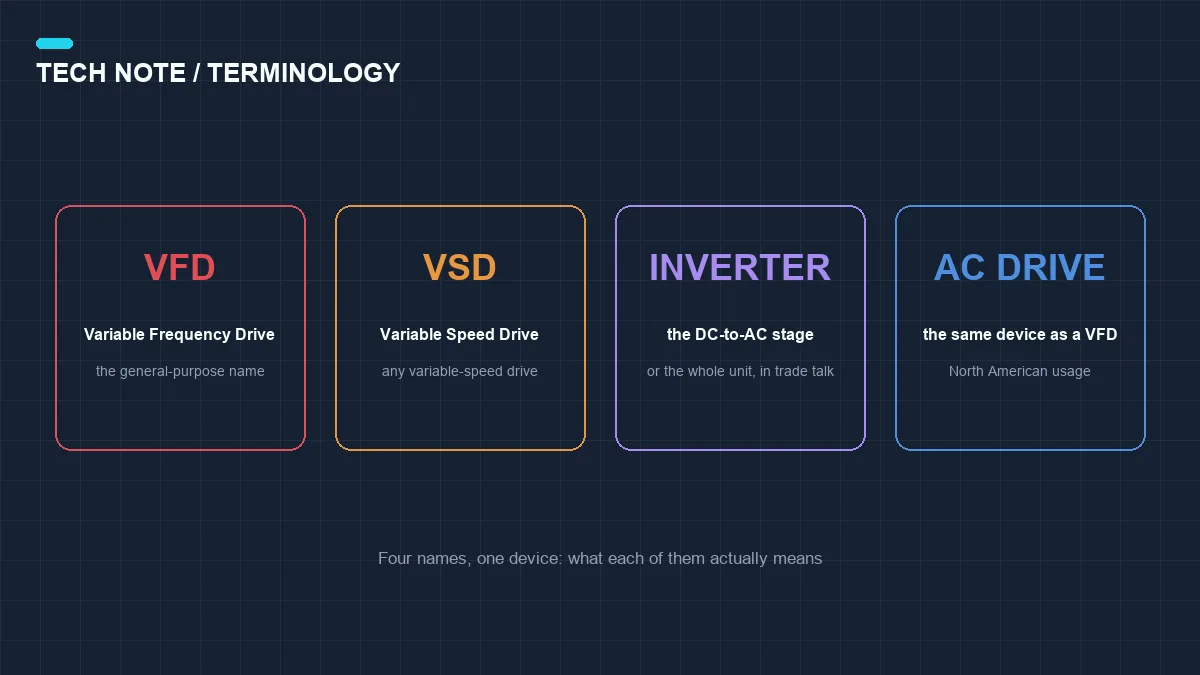
VFD stands for Variable Frequency Drive. It is the power electronics unit wired between the mains supply and an AC motor, and its job is easy to state. It takes a fixed-frequency supply and produces one whose frequency and voltage can both be adjusted. Because an AC induction motor's speed is tied to the supply frequency, adjusting the frequency adjusts the speed. That single relationship is the whole reason for the name.
Variable refers to the output frequency, which can be set anywhere from a fraction of a hertz up to 400 Hz or more. Some models reach 600 Hz. The grid on its own gives you 50 Hz or 60 Hz and nothing in between.
Frequency is the part that does the work. For an AC induction motor, synchronous speed follows n = 120 f / p, where n is speed in rpm, f is the supply frequency in hertz and p is the number of motor poles. A four-pole motor on 50 Hz runs at 1500 rpm. Give it 60 Hz and it runs at 1800 rpm. Move the frequency and the speed follows at once.
Drive marks the unit as the driving device rather than the motor. In English, drive is a general term for a power transmission device. The motor produces torque; the drive decides how that torque is delivered. How the drive does this internally, through the rectifier, DC bus and IGBT inverter stages, is a subject of its own.
So is a VFD the same as a VSD? No. VSD stands for Variable Speed Drive and covers a wider family. Any drive that runs a motor at variable speed counts as a VSD, including DC drives, servo drives and VFDs. A VFD is the frequency-controlled branch of that family. Every VFD is a VSD, but not every VSD is a VFD. On a quotation, VFD is the more precise term and the one least likely to cause confusion.
Is an inverter the same as a VFD? This is where most people go wrong. In electrical engineering, inverter has a strict meaning. It is the stage inside a drive that converts DC bus voltage into three-phase AC, built from IGBTs, and the word itself means a DC-to-AC converter. In pumps, HVAC and air conditioning, though, inverter has become common shorthand for the complete drive. An inverter air conditioner or an inverter pump has a VFD inside it. When a customer asks for an inverter, confirm whether they mean the whole unit or just the module. A complete drive and an inverter module differ sharply in specification, certification and price.
Is a VFD the same as an AC drive? Yes. The two describe the same class of equipment. The difference is habit, not technology. North American catalogues lean toward AC drive, while European and Asian engineering documents usually say VFD.
Other names turn up on drawings, nameplates and tender documents. AFD, short for Adjustable Frequency Drive, is common in North America, as is ASD, Adjustable Speed Drive. European documents use frequency converter or frequency inverter. VVVF, Variable Voltage Variable Frequency, appears in lift and rail projects where the point is that voltage and frequency vary together. FC is simply short for frequency converter. All of them point to the same device.
The variety of names comes from three places. Industrial speed control began with DC drives, so the industry needed a broad term, VSD, to cover both DC control and the frequency-based control that followed. HVAC adopted inverter from domestic air conditioning and carried the word up to large chillers. Naming standards then diverged, with NEMA shaping North American usage and IEC shaping European practice. A drive manufacturer in Wuxi and a systems integrator in Texas are describing the same hardware.
Which word should you use? On a request for quotation, write VFD or variable frequency drive. It is the least ambiguous. Reading a supplier's data sheet, check whether inverter means the complete unit or only the module, and whether VSD means frequency control or an older DC scheme. On a nameplate, expect AC drive or inverter, and do not assume the wrong unit was shipped. In a tender, translate VVVF and AFD back to VFD before comparing technical data. Getting the name right matters less than avoiding the mistake it prevents, which is quoting an inverter module when the customer wanted a complete drive, or treating DC speed control and frequency control as interchangeable.
Once the terminology is clear, the next step is usually selection. The workhorse in most plants is the low voltage VFD in the 380–480 V range, covering pumps, fans and conveyors. A general-purpose unit with both V/f and sensorless vector control handles most of these duties without a firmware change, and a built-in PID loop is enough for constant pressure or constant flow. If you are a panel builder or an integrator specifying for a known duty, send us the motor nameplate and the operating conditions. We normally confirm the model and its parameters within 24 hours.
VFD Applications
Every variable frequency drive (VFD) application is different, because every load behaves differently. These guides explain the drive features that matter for your industry and link to the recommended product range.
All industry guides