
Project location: Corrugated base paper mill, China · By MorZan
Stock Preparation Retrofit at a Corrugated Paper Mill: PMSM Feed Pumps Cut 40 kW
- Plant / customer:
- OCC corrugated base paper mill
- Published:
The mill makes lightweight, high-strength corrugated base paper from OCC — old corrugated containers — on a high-speed paper machine. The retrofit targeted two pumps in the primary stage of stock preparation: the feed pump to the primary screen and the feed pump to the primary cleaner. Both had been driven by asynchronous motors, and both were replaced with permanent-magnet synchronous machines.
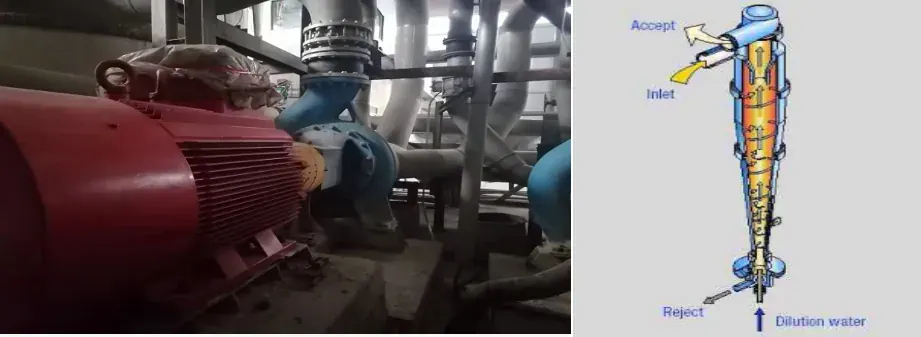
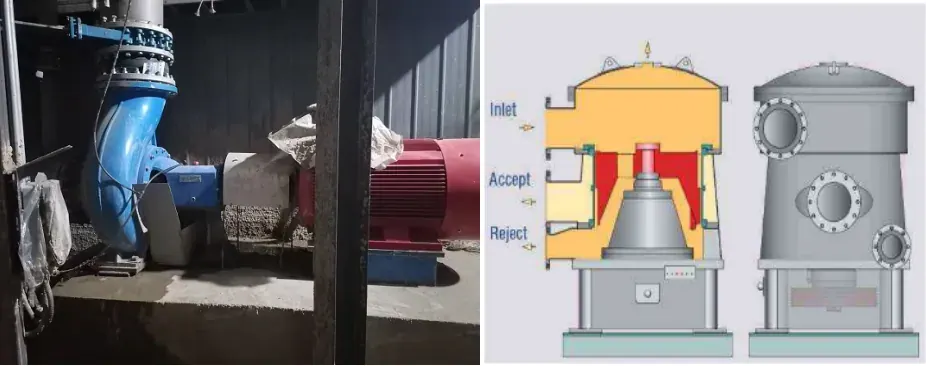
The two devices being driven need different things from their flow. The primary screen feed pump pushes unscreened stock tangentially into the bottom of a screen basket under pressure; the clean fraction passes through the basket and leaves by the accepts line. The primary cleaner uses the difference in specific gravity between fibre and contaminant: stock enters tangentially at pressure and spins at high speed, so heavy particles are flung to the wall and fall to the cone bottom while accepted fibre leaves at the centre.
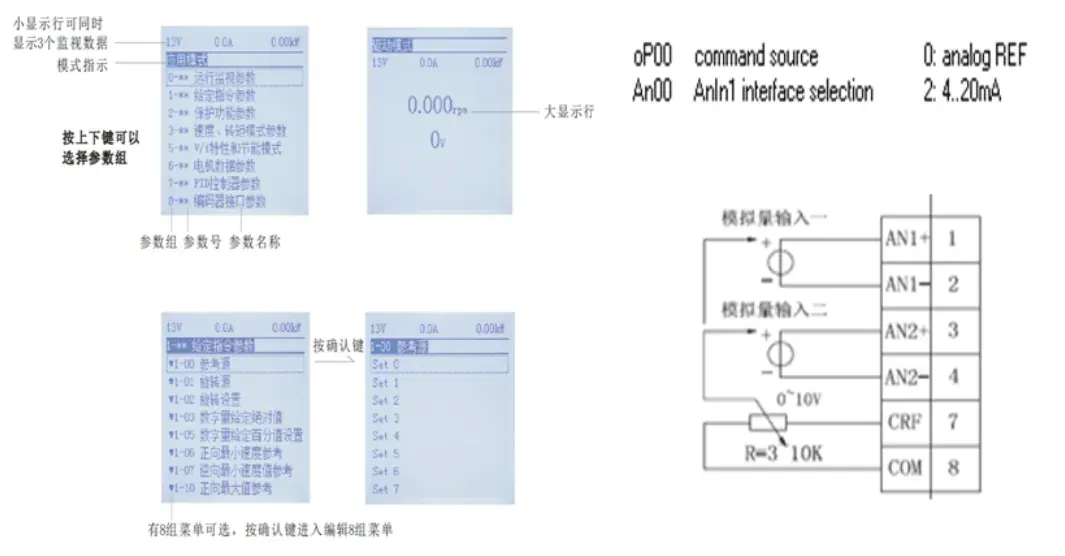
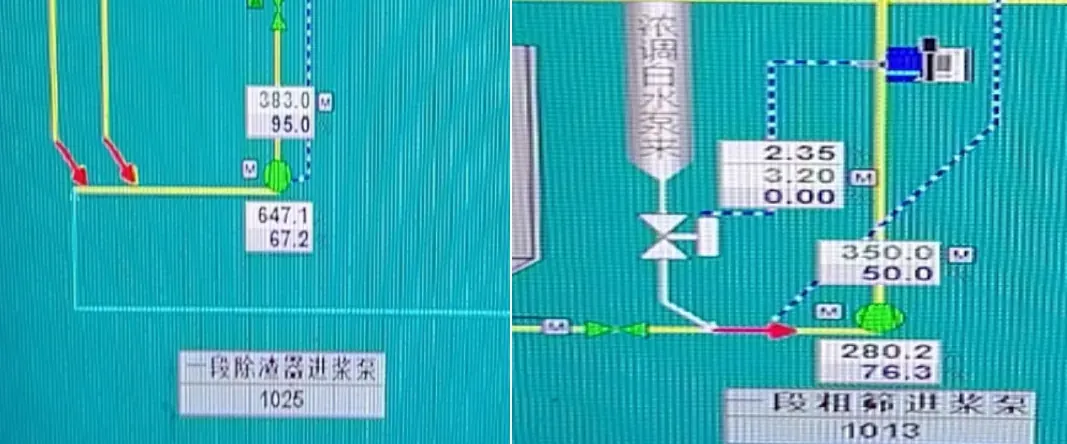
Both duties reward tight flow control, and the mill already had it: the high-speed machines run under a DCS that monitors drive current and feed-pump pressure from the control room. When the stuff chest level falls, the operator raises each pump's pressure — that is, raises motor speed through a 4–20 mA signal — and dials it back when the level is restored. The drives were integrated into that loop, with analogue input 1 configured for the remote 4–20 mA signal.
The reason a synchronous motor saves energy on a pump has to do with reactive power. An induction motor is an inductive load: it draws magnetising reactive power from the grid, which lowers the power factor, and the only way to improve an induction motor's power factor is to keep it heavily loaded — impossible for a pump that throttles down with the chest level. A synchronous motor's rotor current is field excitation, so the power factor can be adjusted through the rotor current and held at unity, or made leading or lagging, regardless of how the pump is loaded.
Sizing was done from motor nameplate current. The cleaner feed pump's synchronous motor is 500 kW at 1,000 rpm with a full-load current of 810 A, so an 880 A, 500 kW drive was selected; the screen feed pump's 200 kW, 325 A motor got a 369 A, 200 kW drive. Commissioning began with motor parameter learning off-load, then the remote analogue input was configured. The measured outcome — confirmed by an energy meter the customer installed ahead of the drive, not by calculation alone — was that the cleaner feed pump at maximum load drew 650 A from the supply where the induction motor had drawn 730 A. Using P = √3·U·I that is about 40 kW less, or 40 kWh every hour of running. At 16 hours a day and 300 days a year the site saves roughly 192,000 kWh, and the customer is now converting the remaining feed-pump motors on the machine family in stages.
Project data
- Process
- Stock preparation, primary screen and cleaner feed pumps
- Motors replaced
- Asynchronous → PMSM, 200 kW (325 A) and 500 kW (810 A)
- Drives
- 369 A / 200 kW and 880 A / 500 kW
- Measured saving
- 40 kW on the cleaner feed pump; ≈192,000 kWh/year
Project photographs
Industry guide for this application
This project sits in the Energy Saving & Retrofit section. The guide covers the duty profile, the machinery and the selection rules for that industry.
Read the Energy Saving & Retrofit guide