
Project location: Wastewater treatment plants, Asia-Pacific and Africa · By MorZan
Decanter Centrifuge Drives on a Shared DC Bus: Recovering the Scroll's Regenerated Energy
- Plant / customer:
- Decanter centrifuge builder
- Published:
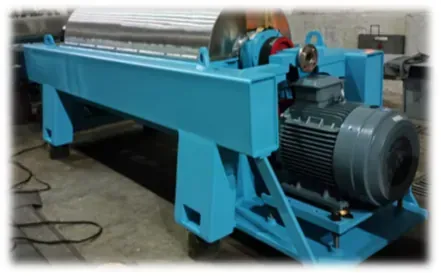
A decanter centrifuge separates solids from liquid continuously. The bowl and the scroll — the helical conveyor inside it — rotate in the same direction at slightly different speeds. Slurry enters the scroll's inner barrel, accelerates, and settles against the bowl wall under centrifugal force; the scroll pushes the accumulated solids towards the conical end and out through the discharge ports, while the clarified liquid overflows at the cylindrical end. Nothing about the process stops, so the speed difference between bowl and scroll is the only handle the operator has on separation quality.
That speed difference is why the machine needs two drives rather than one. The main drive turns the bowl; a smaller drive on the scroll holds the differential. Because the scroll is held back relative to the bowl, its motor spends much of its time being driven by the process rather than driving it — it regenerates. On a conventional installation that energy has nowhere to go but a braking resistor, where it becomes heat in the electrical room.
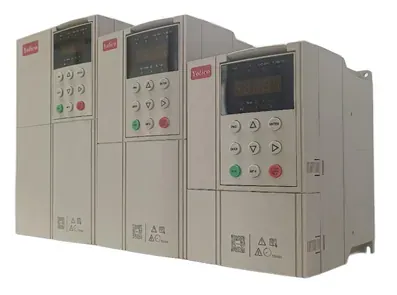
The solution is a shared DC bus. Both YD580 drives — a YD580T4-55G/75P-T for the 55 kW main motor and a YD580T4-11G/15PB for the 15 kW scroll motor — connect to a common DC link. Energy regenerated by the scroll raises the bus voltage, and the main drive drawing from that same bus absorbs it. The heat that used to be dissipated is now doing useful work on the bowl. The main drive runs in V/f or open-loop vector, the scroll drive in open-loop vector, and both report speed and torque back to the plant controller over RS485 using Modbus-RTU, which is also how the differential is calculated and displayed.
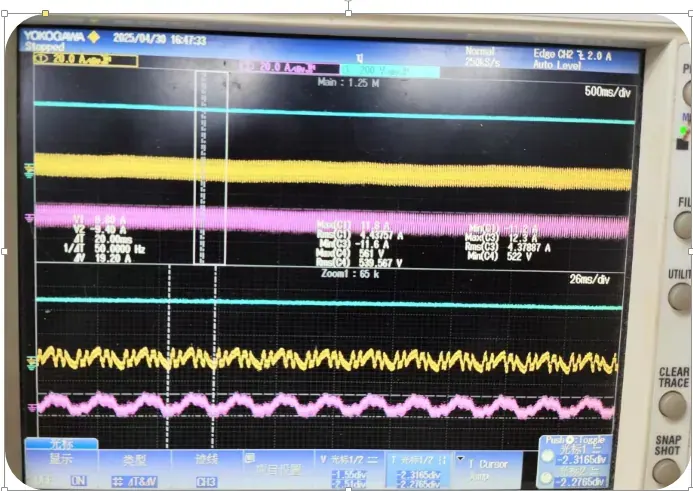
Commissioning was short because parameter sets can be copied between drives through the LCD keypad — useful when a builder ships hundreds of machines and wants identical behaviour in each. Verification used an oscilloscope on the running machine: the incoming R-phase current on the 55 kW drive to check for interference, the U-phase output current to check for vibration, and the DC bus voltage for overall stability.
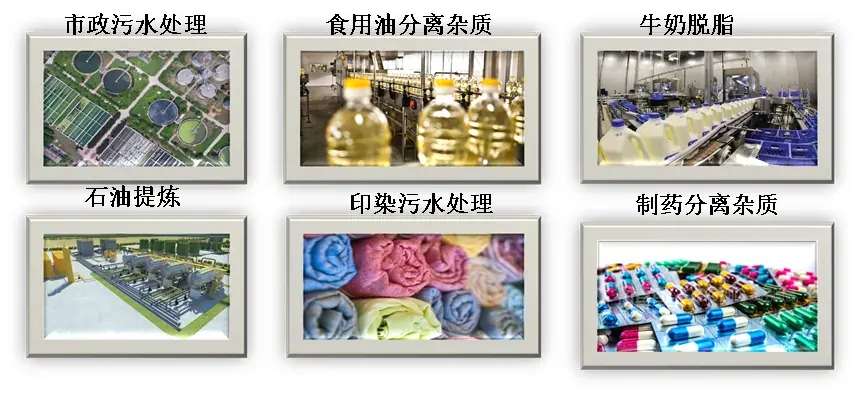
The economics of the shared bus were measured on a real installation at a municipal wastewater plant processing 100,000 t of sewage a year with two centrifuges. With a 10 rpm differential and 15 N·m on the scroll shaft, each machine recovers about 1.5 kW. At 10 hours a day and 300 days a year that is around 4,500 kWh per machine, roughly ¥2,840 a year, so about ¥5,680 for the pair. The same builder had previously fitted imported drives on this machine family; the YD580 replaced them without a change in running behaviour, and because the decanter range spans 11/5.5 kW up to 132/55 kW the same architecture scales across the product line.
Project data
- Machine
- Decanter centrifuge, bowl + scroll
- Drives
- YD580T4-55G/75P-T (main) + YD580T4-11G/15PB (scroll)
- Topology
- Shared DC bus, RS485 Modbus-RTU to the plant controller
- Metered saving
- 1.5 kW per machine; ≈4,500 kWh and ¥2,840 per year each
Project photographs
Industry guide for this application
This project sits in the Petrochemical & Chemical section. The guide covers the duty profile, the machinery and the selection rules for that industry.
Read the Petrochemical & Chemical guide