
Industry selection guide
VFD for Petrochemical & Chemical
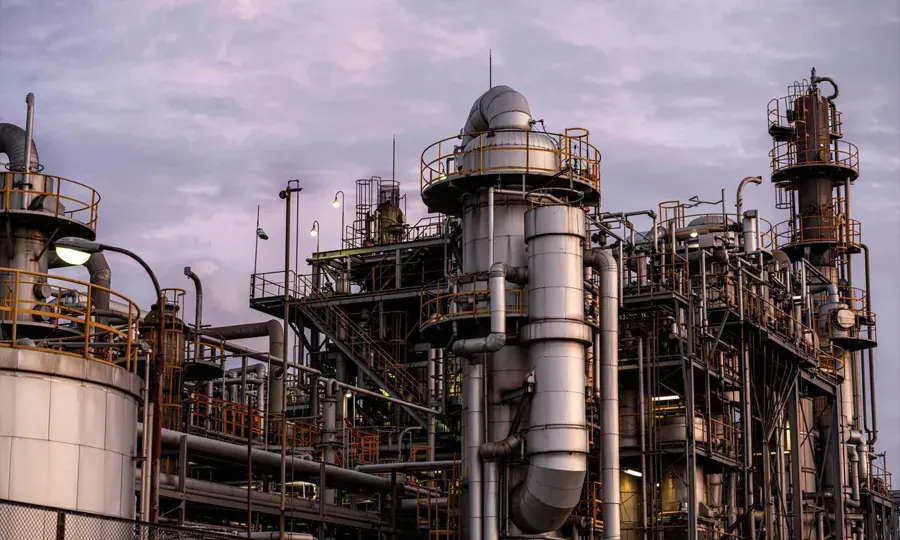
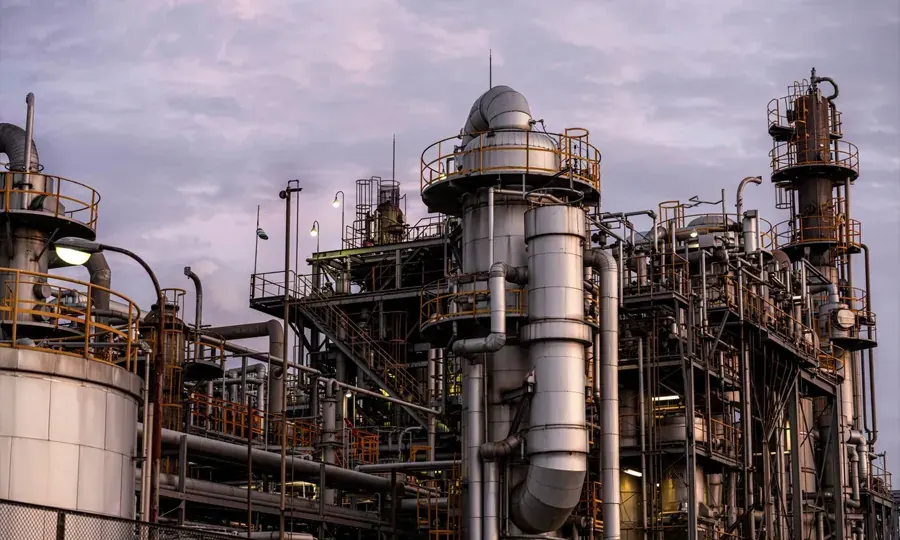
A chemical plant asks a variable frequency drive (VFD) for two things that pull in opposite directions: precise, repeatable speed for the reactions, and absolute reliability in an atmosphere that eats ordinary equipment.
How this industry uses a drive
Chemical processing rewards steadiness over speed. An agitator running slightly slower than the recipe specifies produces a different product; a transfer pump running slightly faster changes the residence time of the whole line. That is why constant-speed operation, not acceleration performance, is the capability this industry buys first, and why a drive here is judged on how well it holds a setpoint rather than how fast it can change one.
At the same time, a chemical plant is one of the least forgiving places to install electrical equipment. Solvent vapours, corrosive atmospheres, dust that can be combustible, wash-down routines and classified zones all constrain where a standard enclosure can go. The right answer is usually not a specialist drive but a standard drive placed correctly — in a pressurised or purged cabinet in a safe area, feeding a motor in the hazardous zone, with the cable route engineered as carefully as the drive selection.

Agitation: what changing the speed really changes
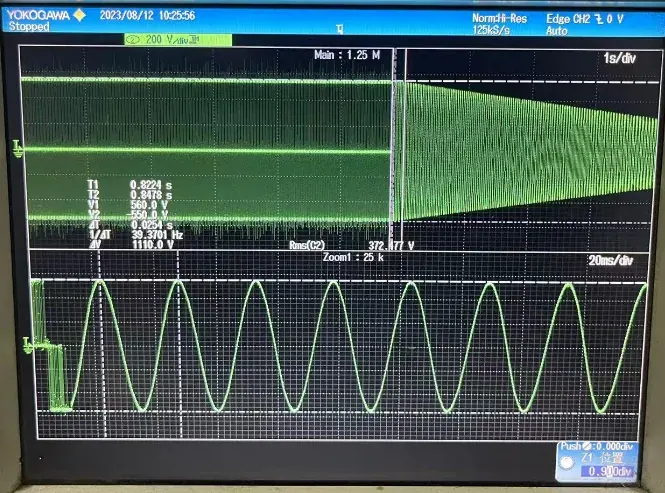
An agitator absorbed power follows a cube law, so a 20 % speed reduction cuts shaft power by roughly half. That is a large number, and it is also the reason a badly applied drive in this industry causes more trouble than it saves: at 80 % speed the impeller also produces less circulation, and in a vessel where the reaction depends on the mixing pattern the difference shows up as a quality deviation rather than a process alarm.
The practical answer is to separate the duties. Where mixing quality matters, the drive is set to hold a fixed speed and its value is repeatability — the same batch every time, regardless of voltage variation or impeller wear. Where the agitator is doing a bulk job such as keeping solids in suspension or preventing a thermal gradient, the speed can be trimmed freely and the energy saving is genuine.
Either way, the starting torque has to be considered. Agitators in viscous or settled media start against a much higher load than they run against, and a large slow-turning impeller with a high-inertia shaft cannot be accelerated quickly without overloading the motor. A long S-ramp and a torque limit set from the motor rather than the drive are the two settings that matter most in commissioning.
Decanters and separation duty
A decanter centrifuge is one of the few machines in a chemical plant where the drive has to control a genuinely difficult load. The bowl is heavy and runs at high speed, the scroll inside it runs at a slightly different speed, and the differential between the two is what determines the dryness of the solids. That differential is small — often under 2 % of bowl speed — so the drive controlling the scroll has to hold its speed with far more accuracy than its own rated accuracy suggests.
Starting a decanter is a sequence rather than a single command. The bowl has to be brought up before the scroll, the feed is introduced only once both are at speed, and stopping has to allow for the bowl's stored energy without letting the differential reverse. A drive that can implement this sequence internally, with its own logic and timers, removes a lot of PLC work and — more usefully — keeps working if the PLC is being serviced.
Energy behaviour is the third consideration. During deceleration the bowl's kinetic energy comes back through the drive, and on a machine started and stopped several times a day that energy is worth recovering rather than burning in a resistor. On continuous machines the more important saving is usually the ability to run the bowl just below its hydraulic limit instead of at a fixed design speed, which raises throughput on a dilute feed.
Hazardous areas and harmonic limits
Electrical equipment inside a classified zone has to be certified for it, and that certification is about the enclosure, not the control algorithm. In practice this means the drive itself almost always lives in a safe area and the classification is handled at the motor and the field wiring. Where the space available forces the drive into the zone, a purged or pressurised cabinet with certified monitoring is the usual route, and it needs to be planned early because it changes the panel dimensions and the cooling load.
Harmonics are the second site constraint. A chemical plant frequently runs at high load for long periods, so the distortion from a diode front end is present continuously rather than intermittently. Where the supply is weak — a plant at the end of a long feeder, or one with its own generation — the drive's contribution to voltage distortion has to be calculated rather than assumed, and a multi-pulse rectifier, passive filter or active front end chosen before the order is placed.
The last item is more mundane but equally decisive: corrosion. Wash-down, acidic atmosphere or salt air will destroy an unprotected enclosure, and the fix is specification rather than maintenance — painted or stainless steel enclosures, sealed cable entries, and cooling paths that do not pull corrosive air through the panel.
Machinery typically driven
- Agitators and stirred-tank reactors
- Decanter centrifuges and separators
- Process and transfer pumps
- Extruders and kneaders
- Vacuum and process blowers
- Cooling-tower and circulation pumps
- Filling and dosing lines
Selection rules to apply
- Decide per agitator whether it is a quality duty or a bulk duty before offering an energy saving — the two need different settings.
- Set the torque limit from the motor's capability, not the drive's, so the drive protects the mixer shaft on a cold start.
- For decanters, check that the drive can implement the start sequence internally, and that its speed accuracy supports the scroll differential.
- Confirm the area classification for the drive location itself, not just the motor, and allow for the panel size a purged enclosure needs.
- Calculate the harmonic contribution at the point of common coupling and specify the rectifier accordingly.
- Specify enclosure finish and cooling path against the actual atmosphere; corrosion is cheaper to design out than to repair.
Series to start from
Confirm the rated current against your motor's full-load current before fixing the model; the frame size follows the overload the machine needs, not the motor nameplate alone.
- YD580
- YD680
- YDS8000
- YD3000N
- Explosion-proof VFD core
Delivered projects in this industry
2 project records from this industry, with the plant, the motor and the measured result.
 Direct-Drive Retrofitting Xanthan Gum Fermentation Tanks: Gearbox Out, 155 rpm InChemical plant, xanthan gum extraction · 2025-08-27A xanthan gum tank stirred at 150 rpm through a gearbox now runs a 160 rpm permanent-magnet motor direct. Production went up, and a metered comparison against a neighbouring tank showed 2,400 kWh saved per 72-hour cycle.
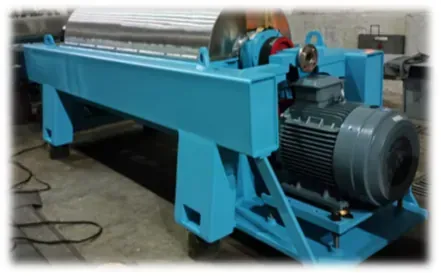 Decanter Centrifuge Drives on a Shared DC Bus: Recovering the Scroll's Regenerated EnergyWastewater treatment plants, Asia-Pacific and Africa · 2025-08-11A decanter runs a bowl motor and a scroll motor at slightly different speeds; the scroll is pushed backwards and regenerates. Wiring the two YD580 drives to one DC bus puts that energy back into the bowl instead of burning it in a resistor.
Related downloads
Manuals, brochures and selection guides for the series recommended above are in the download library.
Other industries
 Mining & Mineral ProcessingHoists, conveyors, mills and dewatering on a mine site
 Steelmaking & MetallurgyRolling mills, converters, conveyors and hydraulic power units
 Cranes & HoistingHoist, trolley and travel motions on cranes and lifts
 Oil & Gas ExtractionPumping units, linear motors and field power
 Fluid Power & WaterSupply, drainage, treatment and industrial fluid systems
 HVAC & Temperature ControlChillers, cooling towers, air handling and district systems