
Project location: Foundry, Hejian, Hebei, China · By MorZan
VFD for a Dust Collector Fan, and Why the Saving Fell to 37 Percent
- Plant / customer:
- Brake disc and casting foundry, twelve-person melting and cleaning crew
- Published:
Dust collector fan VFD retrofit, starting with one sentence at a lunch table
It was said carelessly, in the canteen of somebody else's factory.
I was in Cangzhou for a follow up visit at a foundry making brake discs. We had done that project two years earlier, a 110 kW VFD for a sand handling dust collector fan. At noon I ate in their canteen, a table for four, chicken stewed with potatoes, cabbage, a bowl of seaweed soup.
Halfway through, Liu from the equipment department picked up a piece of chicken and said it offhand. My cousin runs a foundry over in Hejian. Their dust collection has never been right. Last year they hired twelve and nine left.
I did not pick it up. There is a lot of that kind of talk at a lunch table, and most of it is just talk.
On the way back I kept thinking about the nine.
Two weeks later I was in Hejian delivering spare parts to another customer. On the return I took a forty kilometre detour and turned in at that factory gate.
The guard would not let me in.
I said I was there to see whoever was in charge of equipment, about their dust collection fan. He looked up at me and said, you are selling something.
I said no, I came from Cangzhou, I want to look at your dust collection.
He asked if I had an appointment. I said no. He pointed at a bench by the gate and said, then wait.
The bench was concrete with a layer of dust on it. I sat there forty minutes. Halfway through I offered him a cigarette. He did not take it, said smoking was not allowed on shift.
A little after ten a man in his forties came out, surname Ma, in charge of equipment.
I said, Liu over in Cangzhou told me to stop by.
He grunted and said, that is my cousin. Then he added, we are not buying equipment.
I said I am not here to sell equipment. I just want to ask one thing. Is your dust collector fan running at fixed speed twenty four hours a day.
He paused and said, how do you know that.
No appointment, and the foundry dust was heavier than the phone call suggested
I said I heard it. A fixed speed fan always has a slide gate damper hanging on the outlet. While I was waiting at the gate I heard a fan running up on the platform, and the sound was muffled, not the whoosh you get when it is wide open.
He walked me toward the workshop and said on the way, you have good ears.
The moment the workshop door opened, the sound wrapped around us.
Not loud. Muffled. The low frequency kind that sits inside your ears, where you have to shout into someone's ear to be heard.
The floor was covered in black sand, and every step made a fine crunching sound. Light came in from the high windows, and you could see the dust floating in the shafts. I swept my hand through one and the back of it came out grey.
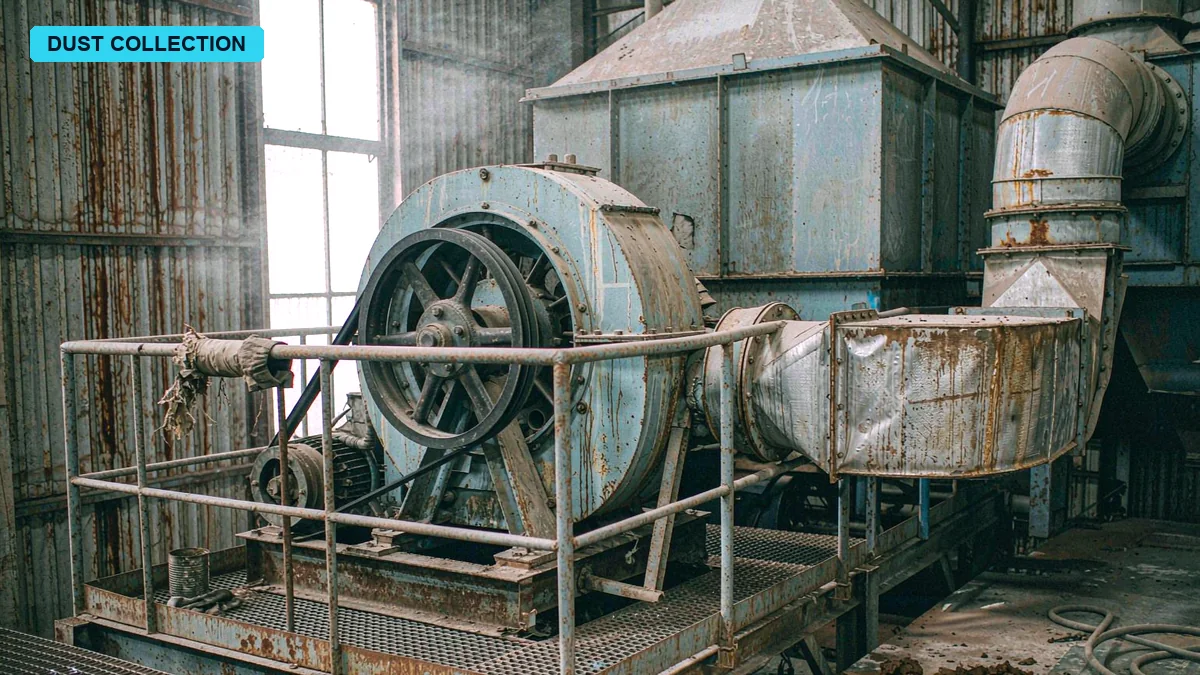
The dust collector sat on a steel platform outside the workshop, just over four metres up, reached by a ladder. I looked for the fan according to the drawing and could not find it. The drawing had the fan standing alone on the roof of the building. On site it was sitting directly on top of the collector, outlet facing west, with the duct turning three bends before it joined the main.
Those three bends went into the calculation later.
A fan platform at 89 dB, and workers stuffing their own ears with cotton
I took the sound level meter out of my bag and stood one metre below the collector platform, A weighted.
The fan was running. It read 89 dB.
An operator on the sand line next to it saw me pull out the instrument and stepped aside. He had cotton in his ears. He had put it there himself. The factory did not issue it.
I walked over and held the meter out to show him. He leaned in, looked at the number, smiled a little, pointed at his ears, and went back to work.
I still remember that smile. Not bitter, not complaining. The look of someone who is used to it.
Ma said beside me, that is only one running. When both are on it is louder.
I asked if the workers wore earplugs.
He said, we hand them out, whether they wear them is up to them. It is hot in there. After a day your ears hurt.
89 dB is the level where national standards say hearing protection is required for an eight hour shift. But protection is not something you solve by handing out a pair of earplugs.
Twelve hired, nine gone, the real reason behind the retrofit
In his office he poured me a glass of water. A disposable cup, the soft kind.
He said the workshop runs six lines in the day and two at night, and the airflow demand is very different. The fan is fixed speed, so the only way to match it is to choke it down with that damper on the outlet.
I asked how far open the damper runs.
He said, seventy percent in the day, forty five at night.
I wrote that down. Choking the airflow saved no power at all and made more noise.
Then he said, last year we hired twelve and nine left.
I asked why they left.
He said, young people walk into that workshop, take one look, and turn around. Some last three days, some a week. Not one of the ones who left said the pay was low.
I asked what they did say.
He said, they say they cannot stand the smell.
He paused, then said, at last year's health check, two suspected cases.
He said that very quietly, and then stopped.
I did not answer either.
Later he pushed the window open a crack and said, the environmental bureau comes once a month to sample, and there is an online monitor. If we go over the limit they fine us. The fine is not the bad part. The bad part is being shut down.
He mentioned one more thing. Next year an overseas customer is coming to audit the factory, and one line on the audit form is workshop environment and noise. He said if we fail that line, the order is gone.
Then he leaned back in his chair and said nothing more.
I sat in his office two hours that afternoon. From beginning to end he never asked how much money a kilowatt hour of saving was worth.
He asked three things.
Whether workers could stand being in there. Whether the environmental sampling would pass. What a lost production day would cost.
I wrote those three sentences in my notebook and read them several times on the way back.
I have been in this trade more than ten years and I had always assumed one thing, that a customer wants a VFD in order to save electricity. Saving energy is the easiest value to explain and the easiest to put on a quotation.
This factory was not that. What he wanted was people.
Three disqualifying checks, motor, ducting and impeller first
Not every dust collector fan is worth converting. I crouched on the platform for over half an hour and went through three things one by one.
Motor insulation and bearings
I meggered the insulation with a 500 V tester and got above 200 megohms, which passes. I listened to the bearings, no periodic noise, no axial play.
This was a Y280S series standard motor, not a VFD duty motor. That is not a disqualifier, but something has to be added later.
Duct leakage
I walked the main duct, a DN800 line, and found six flange joints where I could feel air being drawn in. The worst was at a bend where the gasket had aged, and with my hand against it I could feel the air going in.
Leakage means part of the fan power is being wasted. It does not kill the project, but it has to be fixed first. If you skip it, the numbers after the retrofit will look bad.
Fan impeller
A backward curved centrifugal impeller. Looking in through the inspection door, the blades had some dust build up but nothing serious, and no deformation. Turned it by hand, it moved freely.
All three passed. This fan could be converted.
Ma asked from beside me, so we can put a VFD on it.
I said yes. But what size, how to tune it, and whether the noise can be brought down, that needs calculation first.
75 kW dust collector fan measured 128 A, 73.3 kW at fixed speed
There was a puddle on the platform, rain from the day before that had not dried.
The fan nameplate hung on the side of the motor, half rusted, and the power digits happened to be unreadable. I scraped at it with a fingernail and just made out 75 kW, 1480 rpm, 380 V.
There was another plate on the fan itself and the lettering was clear. Type 4-72 centrifugal fan, 52,000 cubic metres per hour, 3,800 Pa total pressure.
I did not want to trust the plate alone. Motors in plants like this get swapped, repaired and rewound, so the nameplate is only a reference.
I had the electrician energise the fan and clamped the meter on phase U.
128 A.
I waited five minutes and the reading held between 127 and 129. The power factor read 0.87 off the meter in the distribution cabinet.
Three phase power is not complicated, so I worked it out on the calculator right there.
1.732 times 380, times 128, times 0.87.
73.3 kW.
The plate says 75 kW and the measurement says 73.3 kW. That difference is normal, a motor never sits exactly at its rated point.
Closing the damper, and the current only dropped twelve percent
I had the electrician take the outlet slide gate from fully open down to forty five percent, to simulate the night shift.
Current fell from 128 to 112.
Airflow dropped by almost thirty percent and current dropped by twelve.
I had him do it twice and the readings were the same.
That is damper throttling. The air is being choked down, not turned down. You have added resistance to the system, the fan is still at the same speed, and the motor is still doing the same work.
I wrote that in my notebook and circled it.
Every number in this article grew out of those 16 amps.
How to measure hood capture velocity
With the electrical side measured, next came the air.
Six branches fed a shot blasting machine, the sand line, the melting furnace and three grinding stations. I took a hot wire anemometer to each hood face, three readings per point, taking the middle one.
The furthest grinding station read 0.32 metres per second at the hood face.
Below 0.5 metres per second the dust is not captured and escapes around the edge of the hood. Some of that black sand on the workshop floor comes from exactly this.
What the differential pressure gauge reads
There was a U tube manometer on the collector body with the red liquid sitting at 1,800 Pa.
New filter bags run about 800 Pa, so 1,800 means the bags are carrying a fair amount of dust but are not due for replacement yet. Pulse jet cleaning can still hold it.
That number decides where the fan sits on the resistance curve year round, and it also decides how the VFD should be controlled.
VFD selection for a dust collector fan, torque curve before motor rating
With the data collected I went back to the works to select.
Most people open with the question, what size VFD for a 75 kW motor. The question itself is already off.
A fan is a variable torque load, torque rises with the square of speed, and at low speed the load is very light. For the same 75 kW, a fan duty VFD can be one frame smaller than what you would use on a hoist or a crusher, which are constant torque loads.
Our product line is called a fan and pump VFD. What customers type into the search box more often is fan VFD. It is the same thing.
The unit we quoted was 75 kW, three phase 380 V, with a 90 kW light duty rating. The 3 phase 380V VFD is the most common specification here, because almost every low voltage motor in a Chinese plant runs on it.
Light duty sizing allows 110 percent current margin, heavy duty allows 150 percent. For the same 75 kW motor, heavy duty pushes you up two frames.
Sized as heavy duty, the same money only buys 55 kW, and the cabinet goes up a size. The door to that electrical room was only eighty centimetres wide, and a bigger cabinet would never have gone through it.
Why a fan does not need heavy duty
Heavy duty margin is there for shock loads, where current hits twice rated at the moment of starting and the drive has to survive it.
A fan starts softly. The impeller comes up from standstill gradually and needs less than thirty percent of rated torque to start. Heavy duty would be wasted.
V/F control or vector control
A fan does not need vector control. V/F is enough.
But this one had to run long hours between 42 and 50 Hz, and low speed torque had to stay steady. I left the vector algorithm in the parameters and ran it in V/F mode, keeping both. If the process changes later, one parameter switches it over.
I filled out that selection table for other scenarios afterwards.
Woodworking dust collection, cement mill dust collection, biomass boiler dust collection. The fans are all variable torque, so the selection logic is the same.
The difference is bag material and the airflow floor. Wood dust has a harder floor, the chips are light and drift the moment velocity drops. Cement mill bags run at higher resistance, so the pressure setpoint band moves up three hundred pascals.
The affinity law said 66 percent, the customer replied in six words
I was doing the arithmetic on the motorway on the way back.
A fan is a variable torque load. Airflow is proportional to speed and power is proportional to the cube of speed. That is the affinity law, anyone in this trade can recite it.
The night shift runs only two lines, so I estimated night airflow at seventy percent.
0.7 cubed is 0.343.
73.3 times 0.343, 25.1 kW.
That saves 48.2 kW, a reduction of sixty six percent.
At 5,400 running hours a year, that is 260,000 kWh a year, at 0.65 RMB per kWh, 170,000 RMB.
The number was big enough that I did not quite believe it myself. But the arithmetic was sound, so I stopped at a service area and checked it again.
The next day at noon I sent him the result.
That evening he replied on WeChat with six words.
Electricity is not what I care about.
I looked at that message for a long time.
A few minutes later he sent another. He said, work out whether the workers can stand being in there.
I stared at the sentence and did not know what to say for a moment.
The arithmetic was not wrong. The question was wrong.
Airflow floor locked at 85 percent, the real saving is 37 percent
That sentence made me lay the whole thing out again.
If the goal is for workers to be able to stay in that workshop, the first thing to calculate is not how much power you save but how far airflow can come down.
And how far airflow can come down is worked backwards from the capture velocity at the hood.
I went back to the plant. The first time I had only measured the centre of each hood. This time I measured the hood edges to standard, especially at the furthest grinding station.
0.32 metres per second. Drop airflow another thirty percent and that number falls below 0.22. The dust is not just poorly captured, it comes straight out.
Foundry dust contains silica. Breathe enough of it and you get silicosis. That line cannot be crossed.
I worked the minimum requirement at all six hoods back into main duct airflow, and the answer was eighty five percent.
Not seventy. Eighty five.
Recompute.
0.85 cubed is 0.614.
73.3 times 0.614, 45.0 kW.
Then allow for the drive's own losses, divide by 0.97, and it is 46.4 kW.
Saving 26.9 kW, a reduction of thirty seven percent.
145,000 kWh a year, 94,000 RMB.
From sixty six percent down to thirty seven, a drop of twenty nine points.
I sent him that number with one line attached. This is calculated from the process floor, it cannot be pushed any higher.
He replied with one word. Good.
Later he told me he had not believed the sixty six percent for a second. He said, if the fan turns slower the air gets less, and with less air the dust is not caught. You do not need arithmetic to know that.
I asked why he had not said so.
He said, I wanted to see whether you would correct it yourself.
Noise dropped 12 dB, and most of it was not the fan
With airflow settled, noise came next.
The textbook relationship between fan noise and speed is the fifth to sixth power. For a fifteen percent drop in speed, the sound pressure level comes out of a logarithm.
Fifty times log of 0.85, 3.5 dB.
Which means slowing the fan body alone takes 89 dB down to 85.5. That number is meaningless to a worker. 85.5 and 89 are equally unbearable.
Speed alone cannot explain the other 8.5 dB.
What I put in the proposal was fan speed plus removal of throttling, a rough approximation, and it came out at 77. I did not quite believe it myself when I wrote it, but I sent it anyway.
Three months later on the follow up visit, the measurement was 77.
The number matched. The reasoning did not.
That day I put the sound level meter against the ducting and measured along it. 78 on the fan casing, 76 in the middle of the duct, 79 at the bend.
Most of it was in the ducting.
Airflow noise in a duct follows a high power of velocity. Speed down fifteen percent means velocity down fifteen percent, and that falls away much faster than the fan body does. Bends, reducers and branch tees are noise sources the moment velocity climbs.
So most of the noise benefit from a dust collector fan retrofit is in the air path, not in the fan.
That 77 dB was me writing the right answer first and only working out why three months later.
Most proposals do not say this. Because to explain it you have to admit you could not work it out at the start.
Dust collector VFD quote at 46,000 RMB, where the four blocks go
The formal quote was 46,000 RMB, tax included, invoice available, installation and commissioning included, two year warranty.
It breaks into four blocks. The cabinet, meaning the complete VFD control panel, 32,000. The differential pressure transmitter and screened cable, 6,000. Installation and commissioning, 8,000. Freight and consumables separate.
Ma took the sheet to the owner and came back and said, can you get to 35,000.
I said I cannot, but I can tell him where the money goes.
He was not satisfied, and pulled out his phone. What he had typed into the search box was 75 kW VFD price, and up came a pile of listings at 28,000 and 31,000.
He said, this one is only 28,000.
I said that is a bare unit. A drive on its own, no enclosure, no input reactor, no output filter, and no commissioning.
He did the sum. 28,000 plus 3,000 for the enclosure, plus 2,800 for the reactor, plus 3,200 for the filter, plus 8,000 for commissioning. 43,000.
Three thousand cheaper than us.
I said right, three thousand cheaper. But that seller does not commission it. Once this fan is installed there is a resonance near 42 Hz, the PID has to be tuned on site, and the pressure setpoint band has to be set against the bag resistance. He ships you a box. You find someone to tune it. If it does not tune, he says the box is fine.
Ma put his phone away and said nothing more.
What the 32,000 cabinet contains
Inside the 32,000, the drive itself is 24,000, the input reactor 2,800, the output filter 3,200, the enclosure and accessories 2,000.
The reactor and the output filter are the two items most likely to get cut.
Cut the input reactor and harmonics on the grid side climb. This plant also runs induction furnaces, so harmonics are already heavy. Add a drive with no reactor and the capacitor compensation in the distribution board becomes a problem.
Cut the output filter and note the motor cable runs more than forty metres from the cabinet. Long cable plus high frequency PWM puts overvoltage on the motor terminals and insulation ages fast. This was a standard motor and it was never built for that.
The two together are 6,000, thirteen percent of the total.
Both survived. What the owner cut was the installation fee, from 8,000 down to 6,500, on condition that the plant electricians worked alongside us.
The enclosure went to IP54, and the extra 1,200 was my idea
Three days after the quote went out I called back and said the enclosure had to change.
The electrical room sits next to the collector, separated by a wall with a doorway through it. I had looked at it on the first visit. There was a thin layer of dust on top of the cabinet, and when I wiped it with a finger it came away black.
The existing cabinet was IP20 and had been in service two years. The electrician said they had opened it once to blow it out and took out half a dustpan of ash. It had tripped once, and inside they found dust on the contactor tracking across after it got damp.
Foundry dust is not like dust elsewhere. It contains iron. The fine powder from grinding and shot blasting settles on circuit boards and conducts.
IP20 does nothing about that. Those two louvres on a standard enclosure exist for cooling, and the dust comes in through them.
Going to IP54 added 1,200. Sealed enclosure, cooling by fan and filter, positive pressure inside so dust cannot get in.
Ma asked whether that money could be avoided, since everybody else's cabinet was used the same way.
I said, their cabinet took two years to collect half a dustpan of ash. Yours has to last eight.
He agreed.
That 1,200 was not in the original 46,000. I added it myself, which brought it to 47,200.
On the follow up visit I opened that cabinet again. The top still had a layer of dust on it, and the inside was clean. The electrician said they change the filter once a month, the plant does it themselves, we do not need to come.
How to choose a VFD brand, the three questions the owner asked
The owner came in person when we talked price.
His first question was whether we were a manufacturer or a trader.
That question is more practical than the one that followed. It is not that a trader cannot be worked with. It is that when something goes wrong nobody can be pinned down. Who built the cabinet, who set the parameters, who is responsible when it fails. The chain gets long and the answer gets vague.
I said we are a manufacturer. We build the cabinet ourselves and we make the drive itself, this power range comes off our own line. The sensors and cable are bought in, and I will tell you which brand they are.
He nodded, put the quotation on the table, and asked how we compared with the big names.
I answer that question dozens of times a year.
I said three things.
First, have you done a fan load at this rating. Not have you made a VFD, have you done a 75 kW dust collector fan. Those are different things. The difficulty in a dust collector fan is not the power, it is the airflow floor and the resonance band. Someone doing it for the first time spends a week tuning.
Second, is there local service. This cabinet is in Hejian, how fast can you get here when something happens. Most imported brands keep their Hebei service points in Shijiazhuang, three hours from Hejian. We hold spares in Cangzhou, two hours.
Third, will you put the warranty in the contract. Not two years by word of mouth, two years in writing, and whether a failure means repair or replacement, spelled out.
He listened and said, then it is reasonable that you cost a bit more.
I said it is not more. It is the same money buying something different.
Bypass cabinet or not, and why this one had none
Before signing, Ma asked one thing. If this thing fails and the fan stops, does the workshop have to stop too.
I said yes.
He said, then can you add a bypass so it can switch over and run on the mains.
A VFD with bypass is a cabinet with an extra mains circuit and a mechanical interlock, so when the drive faults you transfer to direct on line and keep the motor running.
I did not answer straight away. I asked him one question first. When a dust collector fan runs on the mains, what is the airflow.
He said, full airflow.
I said exactly, full airflow. You are converting it because the airflow is too much. Switching to the mains puts you back where you started, and that damper on the outlet has to close again.
A bypass rescues the machine, not the process.
And a bypass cabinet costs forty percent more, the width goes from eighty centimetres to 1.2 metres, and it would not go through that door.
What we settled on was no bypass, and spares instead. A main board, a fan, a set of fuses, 3,000 RMB, kept in the plant's spare parts store.
If it fails you swap the board first, and we are there the next day.
That clause went into the contract annex.
With the bypass settled, only the schedule was left.
The shutdown window was eight hours, lead time and getting the cabinet in
The second thing he asked about was schedule.
From contract to cabinet on site we quoted eighteen days. There is no stock at this rating, it has to be scheduled into production.
He asked whether it could be faster. I said yes, ten days with an expedite fee of 3,000, but the enclosure would come from another supplier and the colour would not match the existing unit.
He said forget it, eighteen days is fine.
What actually constrains you is not lead time, it is the installation window. The plant only shuts down on Sundays, seven in the morning to three in the afternoon, eight hours.
Past that point, six lines have to run on Monday and cannot stop.
Fitting the work into eight hours
Two hours to strip the old cabinet, two hours to set the new one, two hours to dress and connect, two hours left for commissioning.
That plan depends on one thing, the incoming and outgoing cable positions on the new cabinet lining up with the old one. So a week early I went and measured the terminal layout in the old cabinet and had the new one built with the same entry and exit directions.
If they had not lined up, rerouting alone would have cost another three hours.
One more thing I missed at proposal stage. The electrical room door is eighty centimetres wide and the cabinet is ninety. I had measured the opening and not the frame.
That line was not in the proposal.
Sunday installation, the door frame was ten centimetres narrower than the opening
Installation day was a Sunday, and we were on site at seven.
The first problem was that the cabinet would not go through the door.
The frame was welded angle steel, rusted solid, and the screws would not turn, so we cut it with a disc cutter. That took forty minutes.
Once the cabinet was in, the wiring actually went smoothly. The old wire numbers were still there, a few had been changed, but the main circuits matched.
What was awkward was the wiring. There was an extra set of control wires in the old cabinet running to the workshop office, the dust collector running signal feeding an indicator lamp. It was not on the drawing.
With dust collector VFD wiring, the thing to fear is never the number of wires. It is the wires that are not on the drawing.
I followed the cable to the office and saw a green lamp on the wall, and asked what it was for. The man on duty said when the lamp is on the collector is running, and that is what the environmental inspectors look at.
That circuit could not be broken. I landed it on a dry contact in the new cabinet so the lamp still works.
Three days of commissioning, 39 Hz surge, a reversed transmitter and four parameters
We energised at two in the afternoon.
First a jog to check rotation. The fan rotation was correct and the feel of the air at the outlet was right too.
Then we raised frequency on no load, slowly from zero. Everything was normal up to 30 Hz, and much quieter than at fixed speed.
At 39 Hz the ducting started to shake.
Not vibration. Air hammering back and forth, the duct wall making a low thumping sound. The fan was surging.
I dropped frequency immediately and the shaking stopped. Raise it again and it came back at 39 Hz.
This fan and ducting together have a resonance band around 39 Hz. The fan's natural frequency lines up with the acoustic frequency of the air column in the duct, and the air oscillates back and forth inside it.
The differential pressure transmitter was reversed
With the cabinet installed I connected the differential pressure transmitter and set the drive to modulate on collector inlet to outlet pressure difference.
After energising, the frequency went down instead of up. The larger the pressure difference, the lower the frequency.
The high and low ports were reversed. The transmitter has two ports, one to the collector inlet and one to the outlet. Reversed, the signal is inverted and the PID drives the wrong way.
I climbed the platform, swapped the two tubes, energised again, and the direction was right.
Setting the skip frequency
That resonance band at 39 Hz has to be set as a skip frequency in the drive.
I set the jump band from 37 to 41 Hz, so running skips that stretch and never dwells in it.
The awkward part is that if the process needs an airflow that falls inside that band, skipping it means not enough air. So a floor is also needed, keeping minimum frequency at 42 Hz or above.
Those two parameters pull against each other. Set the band wide and the usable range narrows. Set it narrow and it stops doing its job.
What we settled on was 37 to 41, with a floor of 42.
The pressure setpoint band
At first I set the pressure as a single point, 1,800 Pa. After two days of running the frequency was moving constantly, several times a minute.
Bag resistance is not constant. During pulse jet cleaning the pressure difference drops suddenly and then climbs back slowly. With a single point the drive spends its time chasing that point.
I changed it to a band, 1,700 to 1,900 Pa. Inside the band nothing moves. Outside it, the drive corrects.
The frequency settled, and the motor stopped accelerating and decelerating constantly.
The four numbers that ended up in the cabinet
Minimum frequency 42 Hz, skip band 37 to 41, pressure setpoint band 1,700 to 1,900 Pa, acceleration time 60 seconds.
The acceleration time is 60 seconds because the fan has a lot of inertia. Set it short and starting current spikes, and the drive also crosses the resonance band too fast during start, which puts a mechanical shock through the machine.
Three months later, people can talk in the workshop
The follow up was three months later.
Acceptance was actually held back a month. On energising day we only signed off installation complete. I told him we would sign performance acceptance after a full month of running and one complete electricity bill.
It was signed on the twelfth of July. The bill from the month before the retrofit and the month after sat on one table.
The first thing I did on walking in was listen.
Before, you could hear that muffled fan sound standing at the doorway. This time it was gone. You had to walk closer, and what was there was a flatter sound.
People in the workshop no longer had to shout. That was the most direct change.
The meter read 77 dB. Twelve decibels down on before.
On dust, the plant had bought a portable dust monitor and measured beside the sand line. Before the retrofit 6.8 milligrams per cubic metre, after, 3.1.
The workshop manager said something honest. He said he could not see the electricity bill, but there really was less dust in the workshop, and people were willing to stay.
He only half answered on hiring. This year they hired eight and seven turned up. He did not say how much better that was than before, and I did not ask.
The drive keeps a cumulative energy log, so I exported the data.
The dust collector fan circuit ran 1,360 hours in three months and used 63,200 kWh.
Scaled to 5,400 hours that is 250,900 kWh. Against my calculated 250,560, a difference of 340 kWh, 0.14 percent.
The before figures came out of the plant electrician's logbook. They read the main meter once a month, and I split out the dust collector share by running hours.
Using 128 A for the day and 112 A for the night, calculated as two blocks, the annualised figure is 373,700 kWh.
The difference is 122,800 kWh, a reduction of thirty three percent.
What I quoted the customer was thirty seven.
Those four points come from the baseline. The first time I took the daytime 73.3 kW and multiplied it by 5,400 hours for the year, without allowing for the current dropping at night when the damper closes.
16 A over a year is 20,000 kWh, 13,000 RMB.
Ma laughed when he heard it and said, being off by thirteen thousand is better than being off by a hundred and thirty.
One more change I had not expected.
The night shift now uses the VFD as a switch. They pull the main breaker when they finish and close it again the next morning. I asked why they did not stop it from the keypad. He said pulling the breaker is faster.
The drive runs a self check every time it powers up, and frequent power cycling is not good for the DC bus capacitors.
I stuck a sheet of paper on the cabinet door saying stop with the green button, with an arrow drawn beside it. On the second visit the paper was still there, corners curled.
That way of judging a job is now in our own retrofit checklist.
On a dust collector fan retrofit, the first thing is not the affinity law. It is measuring hood velocity and pinning the process floor. Once the floor is fixed, how much noise can come down and how much energy can be saved both become discussable.
Do it the other way round and the number you produce will always be too high, and pleasantly so.
There is one more thing those six words taught me.
Electricity is the easiest value a VFD can claim. It is not the value every customer wants.
Some of them want the people to stay.
Project data
- Fan
- 4-72 centrifugal, 75 kW, 52,000 m³/h at 3,800 Pa
- Before
- Inlet damper throttled to 45 percent open, motor drawing 128 A
- Drive
- 75 kW Yolico drive in an IP54 enclosure, 39 Hz at the airflow floor
- Result
- 37 percent saving in the estimate, 33 percent over the metered year
- Payback
- 47,200 CNY installed, 5.8 months at industrial tariff
Project photographs
Industry guide for this application
This project sits in the Steelmaking & Metallurgy section. The guide covers the duty profile, the machinery and the selection rules for that industry.
Read the Steelmaking & Metallurgy guide