
Industry insightPublished: · By MorZan
RS485 Modbus or Modbus TCP? Wiring a VFD into a Control System
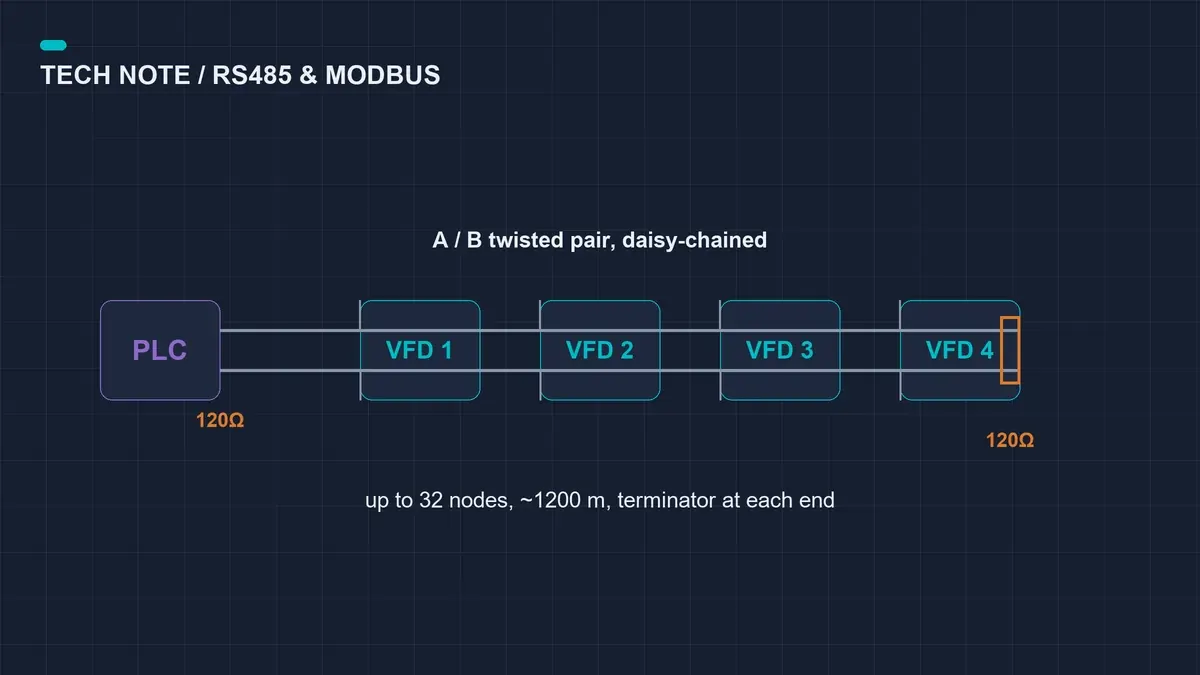
RS485 Modbus RTU runs on two twisted, shielded wires carrying a differential signal at 9,600 to 115,200 bit/s. It daisy-chains up to 32 nodes over roughly 1,200 metres, needs a 120-ohm terminator at each physical end, and tolerates the electrically noisy environment of a motor control room far better than unscreened cable would suggest. Set a unique slave address, a common baud rate and the same parity on every node, and it simply works. This is why it remains the default for panel-level integration with a variable frequency drive (VFD).
The limitation is polling speed, and it is arithmetic rather than opinion. One request-and-response transaction with round-trip latency and the 3.5-character silent gap costs about 10 milliseconds at 19,200 bit/s. Polling 20 drives once each therefore takes roughly 200 milliseconds per full cycle before any retries. If the PLC needs a torque reference updated every 100 milliseconds, serial cannot deliver it — no amount of tuning will change the bus arithmetic.
Specify accordingly. Serial RS485 is the right answer for monitoring, start/stop, speed reference and fault reading on a line of drives that do not need sub-100-millisecond control. Modbus TCP, PROFINET or EtherCAT is the right answer for coordinated motion, fast torque loops or a plant network that already speaks Ethernet. Two practical checks before ordering: ask whether writes go to RAM or to EEPROM, because a cyclic write to EEPROM will wear it out, and keep the comms cable routed away from motor cable and switched-mode supplies to avoid the retries that quietly destroy polling budgets.
VFD Applications
Every variable frequency drive (VFD) application is different, because every load behaves differently. These guides explain the drive features that matter for your industry and link to the recommended product range.
All industry guides