
Project location: Printing works, web press · By MorZan
Web Tension Control on a Printing Press: Keeping Rewind Speed Locked to Web Speed
- Plant / customer:
- Web printing press, unwind and rewind section
- Published:
Printing on a web is a tension problem before it is anything else. Too little tension and the paper slackens, wrinkles, drifts sideways and winds onto the roll with uneven edges. Too much and the sheet stretches, ridges form on the surface, and in the worst case the web deforms or breaks. Holding tension steady is therefore a production requirement, and on this press it is achieved by controlling the speeds of the web and rewind rollers relative to one another — a speed synchronisation problem, not a force control problem.
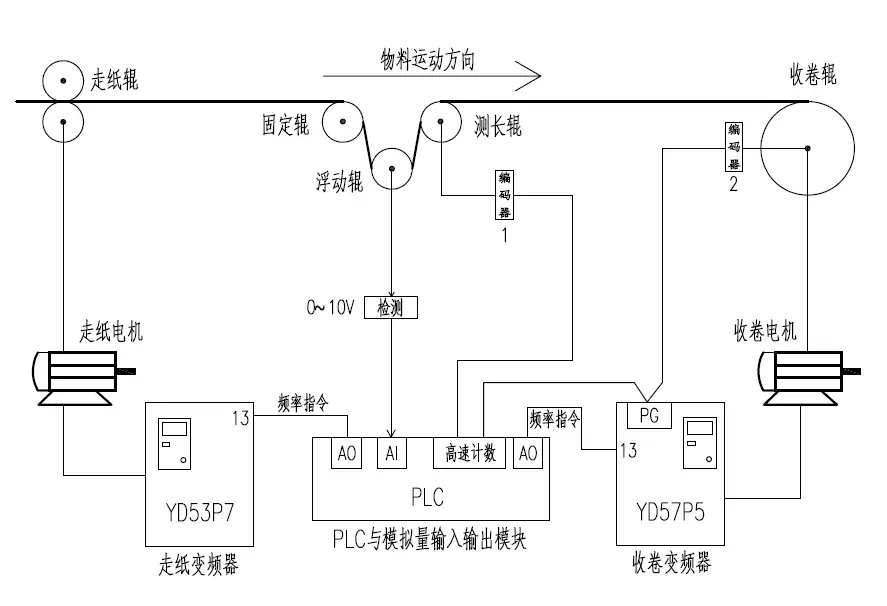
The mechanics are a web roller, a dancer roller with a cylinder, a measuring roller and the rewind roller. The cylinder pressure on the dancer sets the target tension, because the dancer's travel is small and pressure is therefore an accurate proxy for force. Two drives do the work: a YD33P7 T4 BN turning the 2.2 kW web motor in open-loop vector, and a YD37P5 T4 BN turning the 3.7 kW rewind motor in closed-loop vector with an encoder and a PG-B card. A PLC with two analogue inputs and two analogue outputs supervises both.
The central difficulty is that the rewind roll's diameter keeps growing. A 3.7 kW motor running at a fixed frequency would run the paper faster and faster as the roll filled, and tension would fall apart. So the system computes the diameter continuously. A measuring-roller encoder gives the length of paper passing per unit time, and a rewind encoder gives the revolutions of the rewind shaft; length divided by revolutions gives the diameter. The rewind drive's frequency reference is then derived from the web drive's reference, the ratio of web roller to roll diameter, and the mechanical reduction ratio, so both line speeds match.
That calculation alone is not enough, because real presses have friction losses, a web whose elasticity varies, an inertia that changes during acceleration, and motors that are not perfectly matched. The system therefore adds a correction from the dancer. A potentiometer reads the dancer's position; the offset from its centre position is multiplied by the base frequency and a coefficient and applied as a trim of between 5 % and 15 % of the base frequency, bounded so the loop cannot overshoot. The rewind frequency is the base value plus or minus that trim.
Two settings carried much of the commissioning. Both drives had their acceleration and deceleration times set to zero, because the ramp is generated by the PLC instead — the only way to make two motors respond identically is to give them one ramp, not two. And both drives had stall prevention during running disabled, deliberately, so that a momentary dancer movement could not cause the drive to interfere. The final behaviour met the specification: rewind roll diameter varies by a factor of eight across a build, the press runs at any speed up to 180 m/min, the dancer stays within ±5 cm while accelerating and ±1 cm at steady speed, and the drives replaced a magnetic-particle clutch system whose particle wear, heating, maintenance burden and energy use were all worse.
Project data
- Drives
- YD53P7 T4 BN (web) + YD37P5 T4 BN (rewind, closed loop)
- Motors
- 2.2 kW web, 3.7 kW rewind, with encoders and PG-B card
- Controller
- PLC with 2 analogue in / 2 analogue out, dancer potentiometer
- Result
- Rewind diameter varies 8×; speed to 180 m/min; dancer held within ±5 cm accelerating and ±1 cm steady
Project photographs
Industry guide for this application
This project sits in the Printing & Packaging Machinery section. The guide covers the duty profile, the machinery and the selection rules for that industry.
Read the Printing & Packaging Machinery guide