
Industry selection guide
VFD for Cranes & Hoisting
The variable frequency drive (VFD) on a crane is judged on three things: holding a load without drift, releasing the brake without a jerk, and slowing down without dropping anything. This guide covers the control that makes those three happen — the VVVF (variable voltage, variable frequency) behaviour that the lifting industry specifies under that name.
How this industry uses a drive
A crane is a machine that spends most of its life holding something heavy in the air. That single fact drives every requirement on its electrical system. The hoist has to develop full torque at zero speed so the load can be held with the brake open and picked up cleanly; the brake has to be released after the drive has established torque and applied before the drive removes it, or the load drops a few centimetres every cycle; and the travel motions have to accelerate and decelerate a swinging mass without turning the load into a pendulum.
Cranes are also the application where the mechanical benefit of a drive is easiest to argue. A two-speed or contactor-controlled crane drops the load onto the brake, starts with a jerk, and wears out its brake linings during normal operation. A drive ramps in, ramps out, and uses the brake only to hold a stationary load — which, on a crane working continuously, more than pays for the conversion in brake linings alone.
Brake control and torque at standstill
The single most important setting on a hoist drive is not the speed limit, it is the order in which torque and brake are applied and removed. On a lift, the drive must develop torque before the brake opens, otherwise the load rolls back; on a lower, the brake must close only after the drive has taken the load, otherwise the load falls. Modern drives handle this with a mechanical brake control sequence: a torque-proving time, a brake-release delay and a brake-close delay, all adjustable and all needing to be set against the actual brake rather than a default.
Holding a load at zero speed is a separate capability. Open-loop control cannot do it — the drive has no idea whether it is still holding anything. Closed-loop vector control or, for permanent-magnet motors, closed-loop control with encoder feedback can hold zero speed with full torque indefinitely, which is what makes a load-free brake release possible.
Encoder feedback also matters for the travel motions on a crane working to fine tolerances, such as a container or a coil handler, where creep speed has to be predictable. On a simple workshop crane, open-loop vector control with a well-tuned S-ramp is usually enough and costs less.
Anti-sway and load swing
A load hanging on a rope is a pendulum, and a crane operator spends a large part of every shift damping it out by hand. The pendulum period depends on the rope length, so the same acceleration profile that swings a load violently at 30 m of rope may barely move it at 5 m. That is why a fixed ramp is a compromise and why purpose-built crane drives offer sway control.
Sway control works by shaping the acceleration and deceleration profile into two steps whose timing is calculated from the rope length. The first step starts the load moving; the second, applied half a pendulum period later, catches the load at the top of its swing and cancels it. The result is that the operator can command a fast travel and the load arrives nearly stationary.
The function needs the rope length as an input — either measured by a hoist encoder or entered by the operator as a number of fall positions. Even the simplest version, where the operator enters a coarse rope length, removes most of the residual swing and, more importantly, makes the crane's behaviour consistent between operators and between shifts.
Regeneration, panels and the enclosed-trolley question
Every controlled lowering of a load regenerates energy, and on a crane working a fixed cycle that energy arrives often enough to matter. Where several cranes share a DC bus — common on a bridge crane with hoist, trolley and long travel inverters — the energy recovered by one lowering motion is consumed by the others, and the braking resistor is only needed for the surplus. This is one of the few applications where a common DC bus pays for itself purely on energy.
Panels on cranes have to survive weather, dust and, on dockside or steel-mill cranes, heat. Two practical decisions follow. The first is enclosure: an outdoor crane needs a sealed, cooled panel, and the cooling method has to work in the actual ambient rather than an assumed one. The second is mounting: drives mounted on the bridge or the trolley see vibration that cabinet-mounted drives do not, so the mechanical fixing is part of the electrical specification.
Control power is the third question. An outdoor crane with a long festoon or cable-reel supply will see voltage dips, and a drive that faults on a dip stops the crane mid-cycle. Setting the undervoltage trip point, and in some cases adding a ride-through function, is what keeps the crane available on a windy day.
Machinery typically driven
- Overhead travelling and gantry cranes
- Multi-rope friction winders and mine hoists
- Construction hoists and rack-and-pinion lifts
- Electric chain and wire-rope hoists
- Trolley and long-travel motions
- Port and shipyard cranes
- Scrap-handling and ladle cranes
- Stage and industrial lifting platforms
Selection rules to apply
- Specify closed-loop control for the hoist — open-loop control cannot hold zero speed, so it cannot release the brake under load.
- Set the brake sequence against the real brake: prove torque, then release; take torque, then close. Do not accept defaults.
- Fit an encoder on the hoist if you intend to use sway control, because it needs the rope length.
- On a crane with three or more motions, evaluate a common DC bus: it shares recovered energy and removes most braking resistors.
- State the ambient and the mounting location for every panel, and check the drive frame allows the vibration it will actually see.
- For outdoor cranes, review the undervoltage trip setting and consider ride-through before the crane starts nuisance-tripping in bad weather.
Series to start from
Confirm the rated current against your motor's full-load current before fixing the model; the frame size follows the overload the machine needs, not the motor nameplate alone.
- YDS8000
- YD5900
- YD3000N
- YD580
- YDBU
Delivered projects in this industry
2 project records from this industry, with the plant, the motor and the measured result.
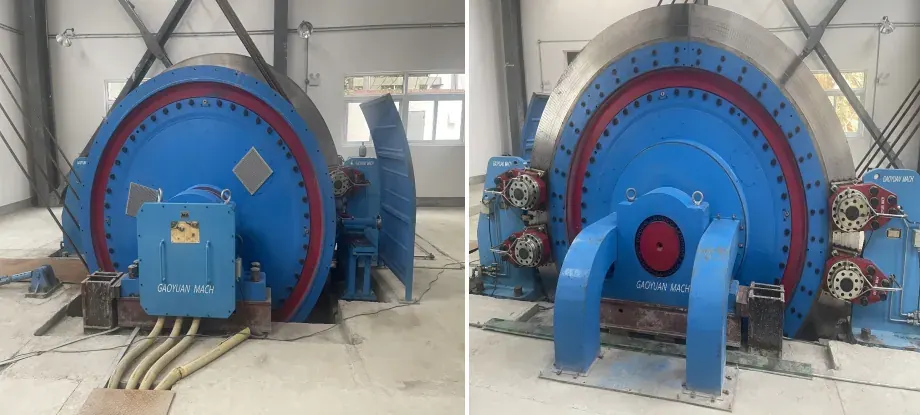 Shaft Hoisting System for a 600 m Fluorite Mine: Direct PMSM Drive Replaces Gearbox and HVFluorite mine, 600 m vertical shaft · 2025-02-17A 630 kW outer-rotor permanent-magnet motor drives a multi-rope friction winder directly from a 380 V drive — no gearbox to maintain and no 10 kV switchgear to buy. Commissioning waveforms at 1.5 and 12.5 rpm, and a 110 % overload test at 0.5 rpm.
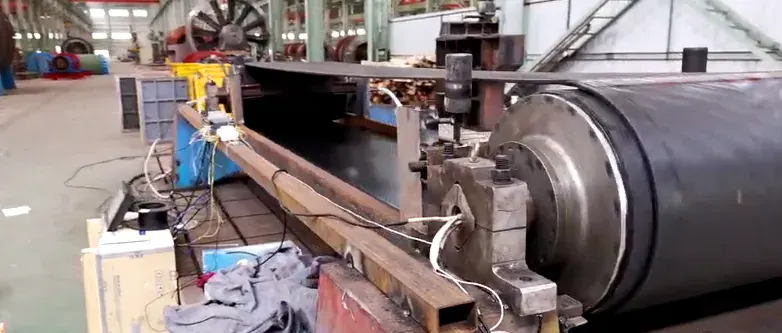 Dual-Drive Permanent-Magnet Belt Conveyor with Load Sharing for a Coal MineCoal mine, main haulage conveyor · 2025-03-29Two drum-integrated PMSM drives share one coal conveyor: the master holds speed, the slave holds torque, and the pair agree to within 5 %. Load current stayed flat at 240 A and a fully loaded belt started at 360 A.
Related downloads
Manuals, brochures and selection guides for the series recommended above are in the download library.
Other industries
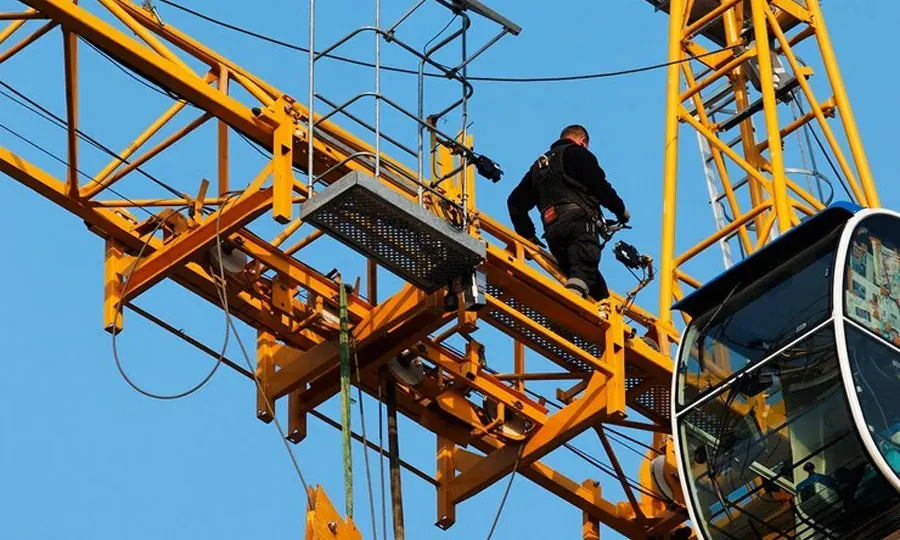 Mining & Mineral ProcessingHoists, conveyors, mills and dewatering on a mine site
 Steelmaking & MetallurgyRolling mills, converters, conveyors and hydraulic power units
 Oil & Gas ExtractionPumping units, linear motors and field power
 Petrochemical & ChemicalReactors, agitators, decanters and transfer pumps
 Fluid Power & WaterSupply, drainage, treatment and industrial fluid systems
 HVAC & Temperature ControlChillers, cooling towers, air handling and district systems