
Industry selection guide
VFD for Mining & Mineral Processing
A mine drives hoists, conveyors, mills and dewatering pumps, and each of them loads a variable frequency drive (VFD) in a different way. This guide sets out the duty each machine imposes, the protection it needs, and which Yolico series to size from.
How this industry uses a drive
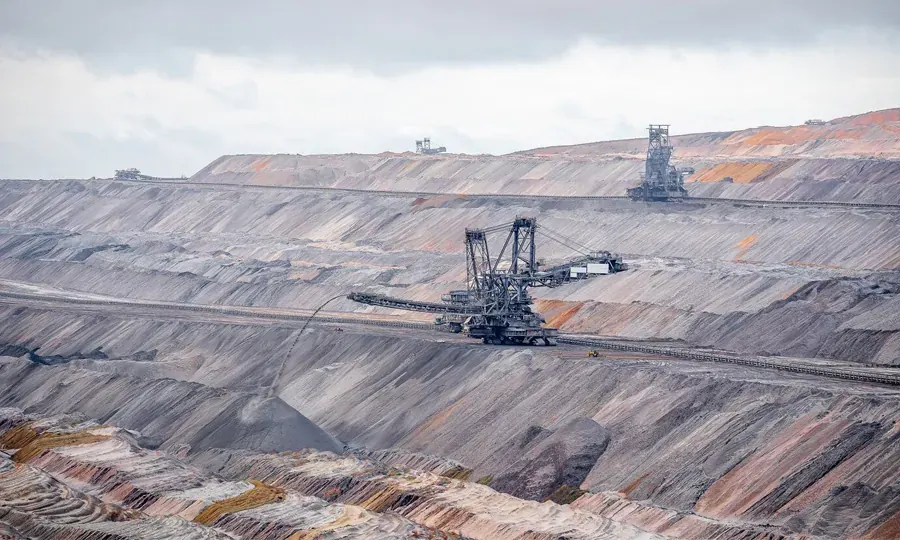
Mining is the hardest duty a variable frequency drive can be asked to survive. A shovel bites into ore and the load jumps from no load to locked rotor in milliseconds; a downhill conveyor pushes power back into the drive instead of drawing it; a mill has to be brought up to speed against the inertia of hundreds of tonnes of steel. On top of that the supply is often a weak remote feeder, the ambient is dust and heat, and the machine is expected to run for years between overhauls.
The result is that mine drives are not chosen by kW alone. A 630 kW hoist and a 630 kW ball mill need completely different drives, because one has to hold torque at half a revolution per minute and the other has to survive a slow ramp against enormous inertia. This guide works through the four machine families found on a mine site, the duty each one puts on the drive, and the settings and options that make the difference between a drive that lasts and one that trips.
Hoisting: torque at zero speed, position without drift
A mine hoist is the only machine on site whose failure is measured in people as well as tonnes. It moves ore, waste, materials and miners, so the drive has to hold the conveyance still at standstill with the brake released, follow a speed reference smoothly enough that the rope never goes slack, and know the position of the cage at all times.
That rules out open-loop control. A hoist drive needs encoder feedback — a SinCos encoder for a permanent-magnet machine, because the motor needs to know its rotor position before it is allowed to develop torque — plus a mechanical brake sequence interlocked with the drive's own run signal, and a speed reference profile that is checked against the actual speed, not assumed.
Rope length changes the load, and the same cage is heavier when it is loaded than when it is empty. The drive therefore has to be commissioned in a fixed order: learn the encoder offset with the conveyance empty, run the system dry, then wind the rope on and trim the parameters under load while recording speed command, actual speed, torque and current together. Only when the recorded crawl speed matches the design duty can the hoist be handed over.
Conveying: breakaway torque and load sharing
A loaded belt conveyor is a constant-torque load that has to be broken away from rest. The belt may have sat still overnight with ore on it, the idlers are cold and stiff, and the drive has to develop between 150 % and 200 % of rated torque before anything moves. Once it moves, the acceleration has to be gentle: jerking a belt spills material at the transfer points and, on a long installation, sends a tension wave down the whole line.
Long belts are usually driven from both ends or from the head and an intermediate pulley, and those two drives have to agree on what they are doing. Without load sharing, one drive takes more than its share, runs hotter and wears its belt cover faster. Sharing can be done through a master and follower relationship over a communication link, or through droop control, where each drive lets its speed fall slightly as torque rises until the two settle at a common operating point.
Downhill sections reverse the energy flow. When gravity pulls harder than friction, the motor is driven by the belt and the drive has to send that energy somewhere: into a braking resistor and chopper, or back onto the network through a regenerative front end. Sizing that path correctly is what stops an overvoltage trip at the moment the belt starts to run away.
Grinding, dewatering and the site conditions
Ball and rod mills are inertial loads where the drive is bought as much for what it stops as for what it starts. A direct-on-line start draws five to seven times rated current, hits the gearbox with the full starting torque and makes the local voltage dip; a controlled ramp removes the inrush, protects the girth gear and the bearings, and gives the plant a speed setpoint it can trim to ore hardness. Because the mill is often the largest single load on site, the drive also has a role in cutting the monthly peak-demand charge.
Dewatering and slurry pumps are the opposite problem: ordinary variable-torque loads in an environment that destroys ordinary equipment. Run-dry protection is not optional, because a slurry pump asked to run without liquid destroys its own seals within minutes. Long cable runs between a remote substation and a borehole or a sump make the motor terminal voltage behave very differently from the drive output, so the drive either has to compensate for cable impedance or be fitted with an output filter.
Finally, the site itself has to be engineered for. Ambient above 40 °C, altitude above 1,000 m and heavy conductive dust all reduce what a drive can deliver, and all three have published derating curves that must be applied before the frame size is fixed. Enclosure choice — IP54 or a dedicated cabinet — follows from how close the drive sits to the crusher, not from what is cheapest.
Machinery typically driven
- Multi-rope friction winders and cage hoists
- Main and drift belt conveyors
- Apron and vibrating feeders
- Ball, rod and SAG mills
- Slurry and tailings pumps
- Mine dewatering pumps
- Jaw, cone and impact crushers
- Wire saws and stone cutting machines
Selection rules to apply
- Size the drive on motor full-load current, then confirm the frame tolerates the overload the machine actually needs — 150 % / 60 s for a conveyor, 180 % / 5 s for a crusher.
- Specify an encoder card for every hoist, and SinCos or resolver feedback for a permanent-magnet machine.
- Calculate the braking duty on downhill belts and fit a chopper with a resistor, or a regenerative front end if the site recovers energy regularly.
- Apply the ambient, altitude and cable-length derating curves before fixing the frame size, and add an output dv/dt filter where the motor cable exceeds the published limit.
- For multi-drive conveyors, decide master/follower or droop control at design stage — retrofitting load sharing onto an uncontrolled pair is far more expensive.
- Choose IP54 or a dedicated control cabinet based on distance to the dust source, not on capital cost alone.
Series to start from
Confirm the rated current against your motor's full-load current before fixing the model; the frame size follows the overload the machine needs, not the motor nameplate alone.
- YDS8000
- YD5900
- YD580
- YD680
- YDBU
Delivered projects in this industry
4 project records from this industry, with the plant, the motor and the measured result.
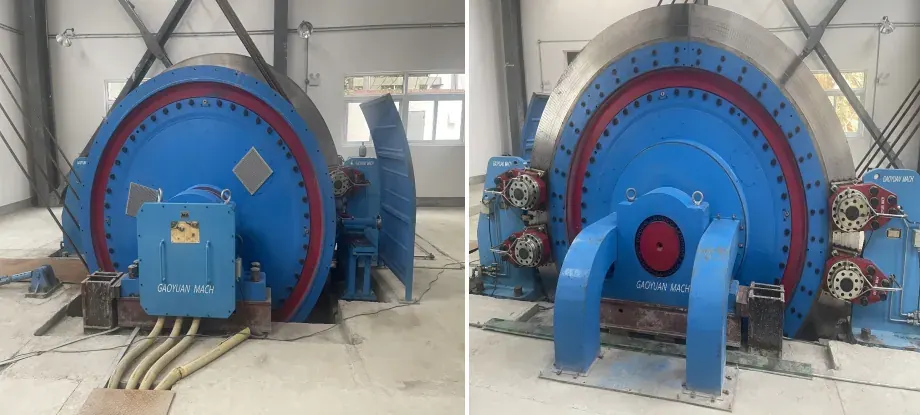 Shaft Hoisting System for a 600 m Fluorite Mine: Direct PMSM Drive Replaces Gearbox and HVFluorite mine, 600 m vertical shaft · 2025-02-17A 630 kW outer-rotor permanent-magnet motor drives a multi-rope friction winder directly from a 380 V drive — no gearbox to maintain and no 10 kV switchgear to buy. Commissioning waveforms at 1.5 and 12.5 rpm, and a 110 % overload test at 0.5 rpm.
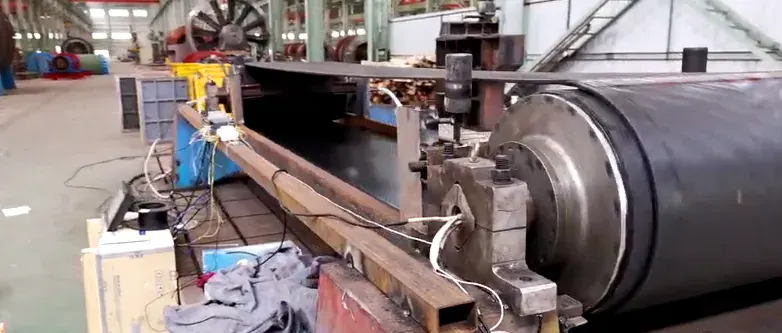 Dual-Drive Permanent-Magnet Belt Conveyor with Load Sharing for a Coal MineCoal mine, main haulage conveyor · 2025-03-29Two drum-integrated PMSM drives share one coal conveyor: the master holds speed, the slave holds torque, and the pair agree to within 5 %. Load current stayed flat at 240 A and a fully loaded belt started at 360 A.
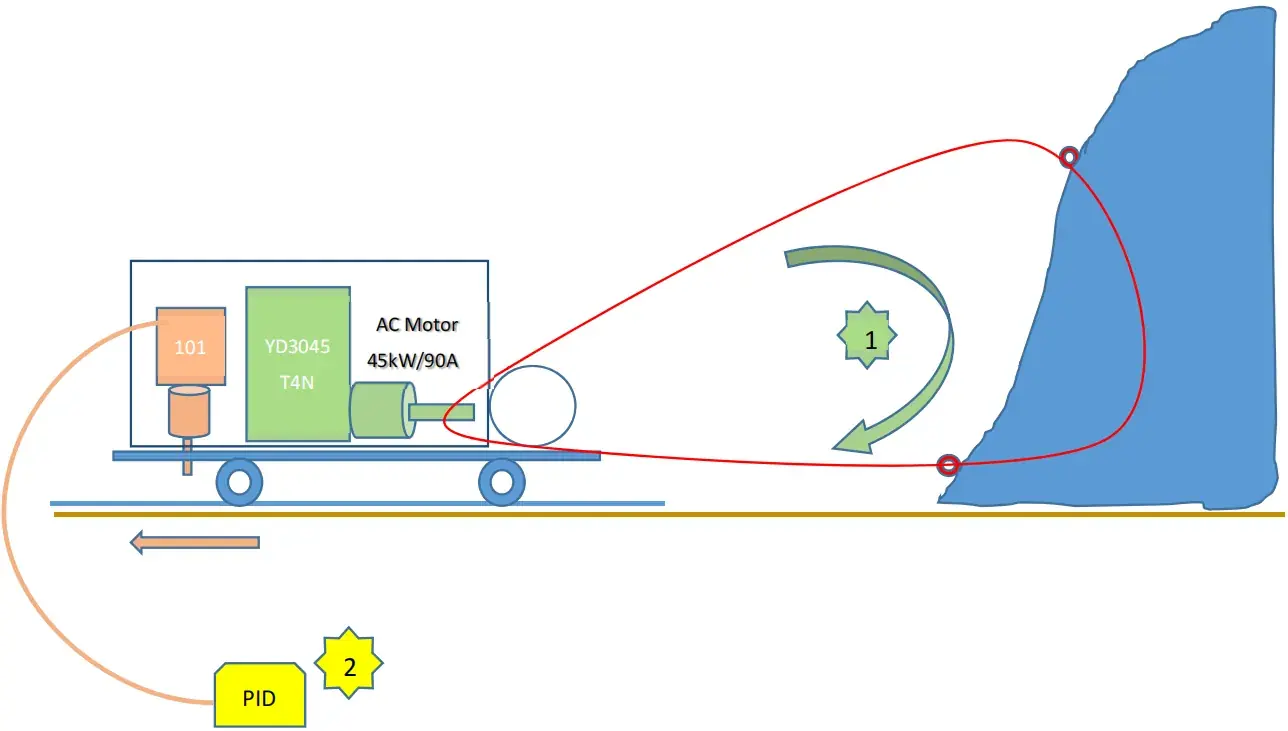 Curing Overcurrent Trips on a Quarry Wire Saw: Free-Run Stop and Torque LimitsStone quarry, wire saw cutting · 2025-03-29A 45 kW wire saw tripped on OC at start and mid-cut. Two settings were responsible, not the drive rating: a free-run stop that let the wire jam the kerf, and a torque limit far above what the motor could use.
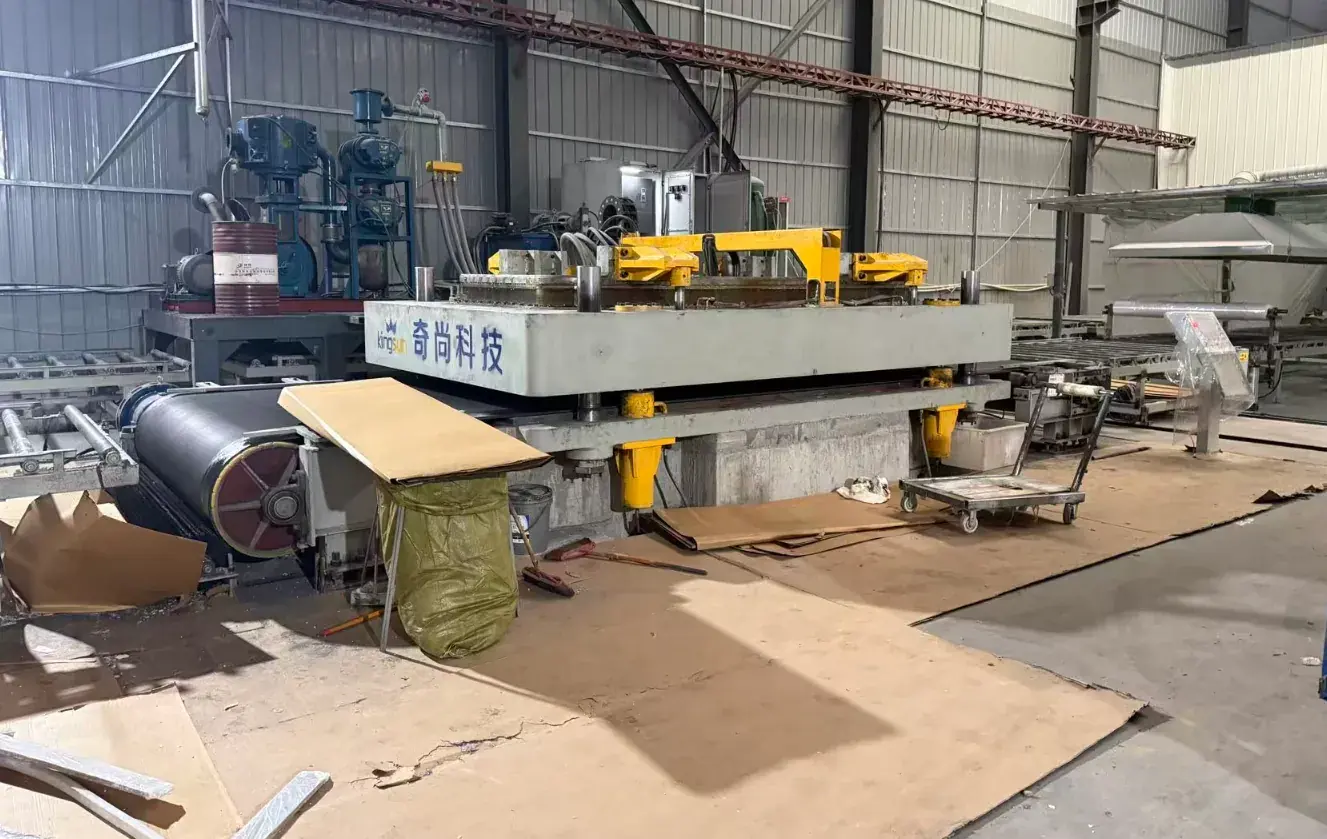 Vibro-Compacting Press for Engineered Quartz Slabs: Drive Selection for a High-Inertia ShakerLinyi, Shandong, China · 2025-12-26Quartz slab presses compact a resin-and-quartz mix with 28–51 Hz vibration under vacuum. The vibration motor has a heavy eccentric load, so drive selection follows starting inertia, not just the 110 kW nameplate.
Related downloads
Manuals, brochures and selection guides for the series recommended above are in the download library.
Other industries
 Steelmaking & MetallurgyRolling mills, converters, conveyors and hydraulic power units
 Cranes & HoistingHoist, trolley and travel motions on cranes and lifts
 Oil & Gas ExtractionPumping units, linear motors and field power
 Petrochemical & ChemicalReactors, agitators, decanters and transfer pumps
 Fluid Power & WaterSupply, drainage, treatment and industrial fluid systems
 HVAC & Temperature ControlChillers, cooling towers, air handling and district systems