
Industry selection guide
VFD for Fluid Power & Water
Pumping is the largest single category of motor load in industry, and most of it is still controlled by a valve. This guide covers what changes when the valve is replaced by the speed command of a variable frequency drive (VFD).
How this industry uses a drive
Throttling a pump is a way of turning electrical energy into noise and heat. The pump runs at full speed and the valve destroys the surplus head; a drive instead slows the pump until it produces only the head the system actually needs. Because pump power follows the cube of speed while flow follows its first power, the saving at partial flow is disproportionately large, which is why water supply is the single most common VFD retrofit in the world.
But the saving is not the only change, and on a water system the other changes matter more than the energy. Slowing a pump changes the pressure profile of the whole pipe network, which can move a surge problem from one point to another. Starting a pump on a ramp removes the pressure wave that a direct-on-line start sends through the mains. Stopping one on a ramp — rather than letting a check valve slam — removes the water hammer that breaks bends and cracks joints. Many projects are approved on energy and justified afterwards on pipework that stopped failing.

Constant pressure and the pump curve
The classic water-supply application is a pump set holding a constant pressure at a discharge sensor. The drive reads the pressure, compares it with the setpoint and adjusts speed through a PID loop. Water systems, however, have more compliance than the stable loop a simple PID expects, so the loop has to be tuned slowly, with a sleep function to stop the pump when demand disappears and a wake function to start it again on a pressure drop.
Two mistakes are common. The first is to run the drive in a control mode that does not maintain torque at the low end of the speed range, which leaves the pump unable to hold pressure when demand is small. The second is to size the drive on the pump's rated power rather than on the motor's full-load current, which looks fine on paper and trips the first hot afternoon.
Where several pumps run in parallel, the useful function is not a faster PID but a staged control scheme: one pump modulates while the others run at fixed speed or switch in and out, with the duty pump rotating so no single machine takes all the wear. That logic usually lives in the drive or in a small controller, and it is worth deciding early whether it will be implemented in the drive or above it.
Recovering pressure instead of throttling it
Where a process has fluid falling or draining from a high point to a low one, the energy in that fluid is usually thrown away in a regulating valve. A four-quadrant drive can instead let the pump run as a turbine, holding the flow at the required rate while feeding the recovered energy back to the network. This is the logic behind condensate recovery in steam systems, and behind pressure-reduction installations on water mains.
Designing one of these systems is a matter of getting the energy balance right. The turbine performance at the operating point has to be mapped, the generator has to be able to run over the full speed range that the flow demands, and the regenerative path has to be sized for continuous duty rather than for a braking transient. It is a genuine engineering project rather than a product selection, and the payback is correspondingly long — but where a pressure reduction is needed anyway, the marginal cost is only the drive and the machine.
The other form of recovery needs no turbine at all. Where a plant has several pumps on one network, the energy recovered during deceleration of one can supply the acceleration of another through a shared DC bus. On a plant with a lot of starting and stopping, this alone removes most of the braking resistors.
Protection: dry running, level and long cables
Most pump failures are not electrical. A submersible pump that loses its water supply destroys its seals and its motor in minutes; a borehole pump running against a closed valve overheats; a sewage pump cycling too often wears out its mechanical seal years early. The drive can protect against all three, but only if the protection is configured rather than left at default: minimum current or power thresholds for dry running, a minimum speed and a maximum frequency of starts, and a level input for a wet well.
Long cable runs between the panel and the pump are common and are a specification issue rather than a tuning issue. Beyond a published distance the voltage at the motor terminals overshoots the drive output because of the cable's own impedance, and the motor insulation degrades over months rather than failing immediately. The remedies — input and output reactors, a dv/dt filter or a sine filter — are chosen from the cable length and the motor insulation class; the drive frame has to allow for the filter from the start.
The last point is commissioning data. A pump's healthy running current recorded on day one is the most useful diagnostic the site will ever have, and a drive that can store and compare it will find a worn impeller or a partly closed valve long before it becomes a failure. Writing that baseline down, and setting the alarm thresholds from it, is a ten-minute job that pays for itself once.
Machinery typically driven
- Booster sets for buildings and campuses
- Borehole and deep-well submersible pumps
- Sewage and drainage pumps
- Water-treatment and dosing pumps
- Cooling-water circulation pumps
- Condensate recovery pumps
- Industrial process and transfer pumps
- Screw and progressive cavity pumps
Selection rules to apply
- Size on motor full-load current, never on pump nominal power, and confirm the drive keeps torque control at the bottom of the speed range.
- Fit a pressure transducer with a short time constant and allow commissioning time for the PID — a default loop will hunt.
- Configure sleep and wake, minimum speed, dry-run current and starts-per-hour limits as part of the delivery, not as a later tweak.
- Where pumps are paralleled, decide whether staging logic lives in the drive or a controller before ordering.
- Check the cable length against the drive's published limit and specify the filter at order stage if it exceeds it.
- Record the healthy running current at commissioning and set alarms from it.
Series to start from
Confirm the rated current against your motor's full-load current before fixing the model; the frame size follows the overload the machine needs, not the motor nameplate alone.
- YD580
- YD580E
- YD581
- SPG
- YD3000N
Delivered projects in this industry
3 project records from this industry, with the plant, the motor and the measured result.
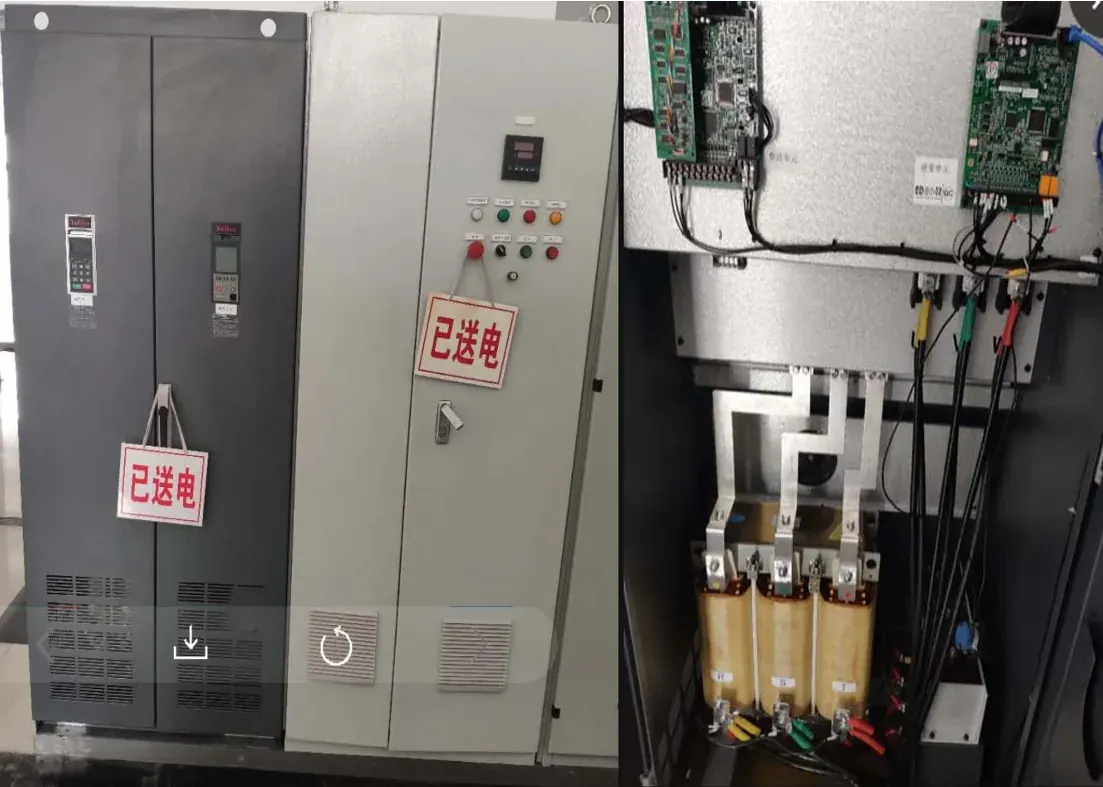 Generating from Condensate Pressure at a Fertiliser Plant: Four-Quadrant Drive Returns 80 kW to the GridXinxiang, Henan, China · 2025-03-29Steam condensate leaving a fertiliser plant still carried usable pressure. A turbine impeller coupled to a permanent-magnet motor, run by a 132 kW four-quadrant drive, now exports 80–90 kW back to the grid.
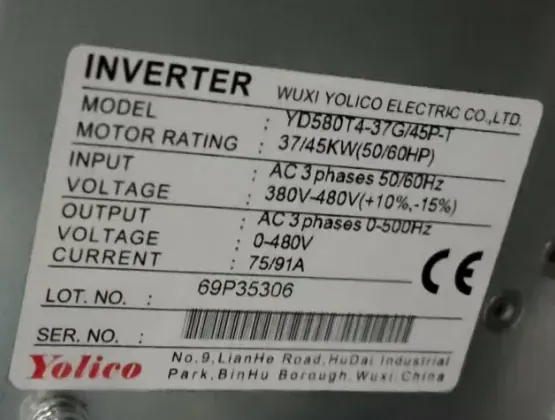 Campus Air-Conditioning Circulating Pump Drive in Yixing: Selection and CommissioningYixing, Jiangsu, China · 2025-09-16A 45 kW chilled-water circulating pump on a university campus runs on a YD580T4-37G/45P-T with terminal start, analogue frequency reference and separate run and alarm relays. Measured current: 68 A balanced.
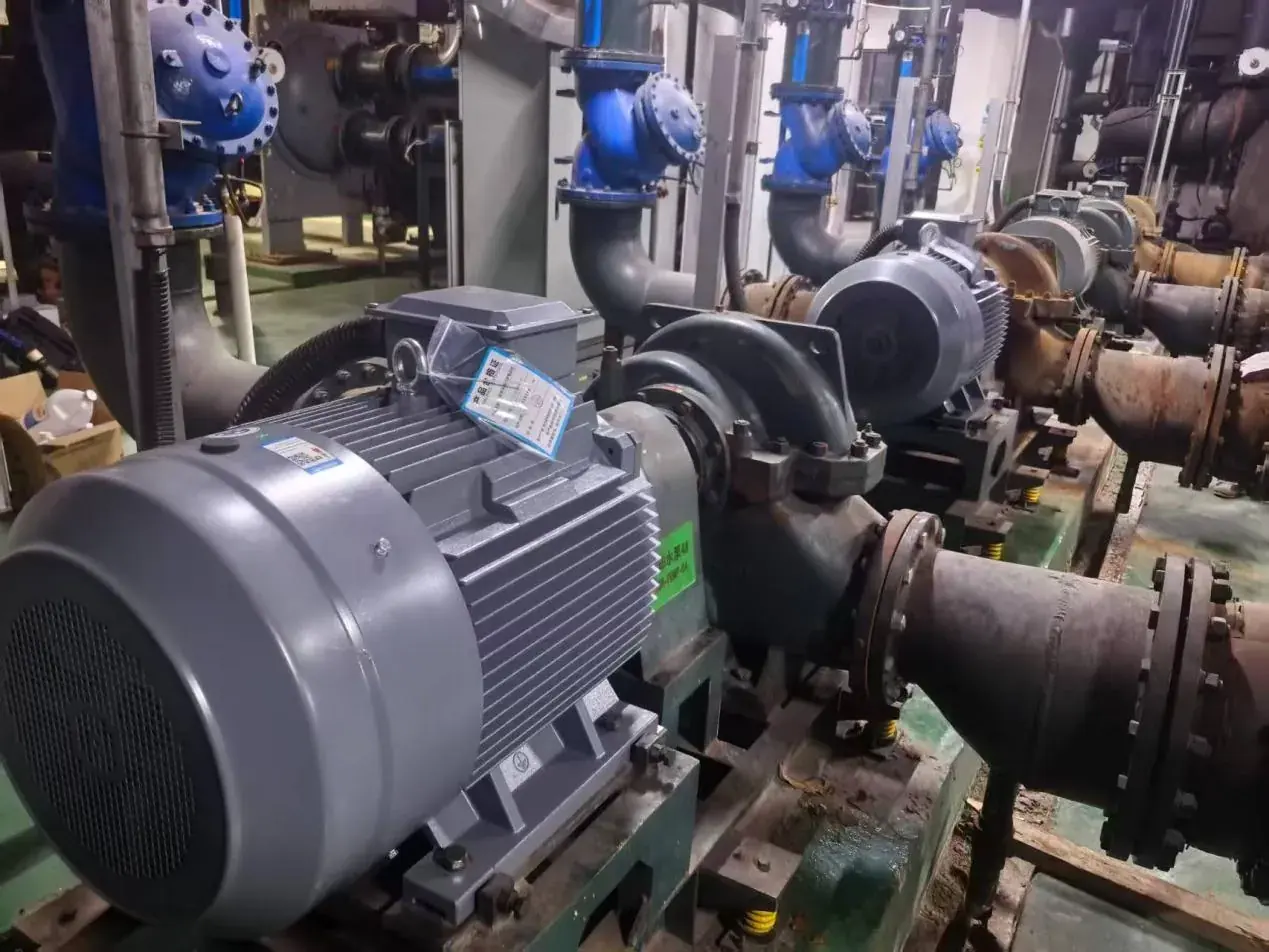 Cooling Water Pump Retrofit with a Permanent-Magnet Motor in ZhangjiagangZhangjiagang, Suzhou, China · 2026-01-16A cooling water pump driving an industrial chiller was converted to a 75 kW permanent-magnet motor on a 150 A YZJ580E drive, with local/remote control from the panel door and run and fault signals back to the plant PLC.
Related downloads
Manuals, brochures and selection guides for the series recommended above are in the download library.
Other industries
 Mining & Mineral ProcessingHoists, conveyors, mills and dewatering on a mine site
 Steelmaking & MetallurgyRolling mills, converters, conveyors and hydraulic power units
 Cranes & HoistingHoist, trolley and travel motions on cranes and lifts
 Oil & Gas ExtractionPumping units, linear motors and field power
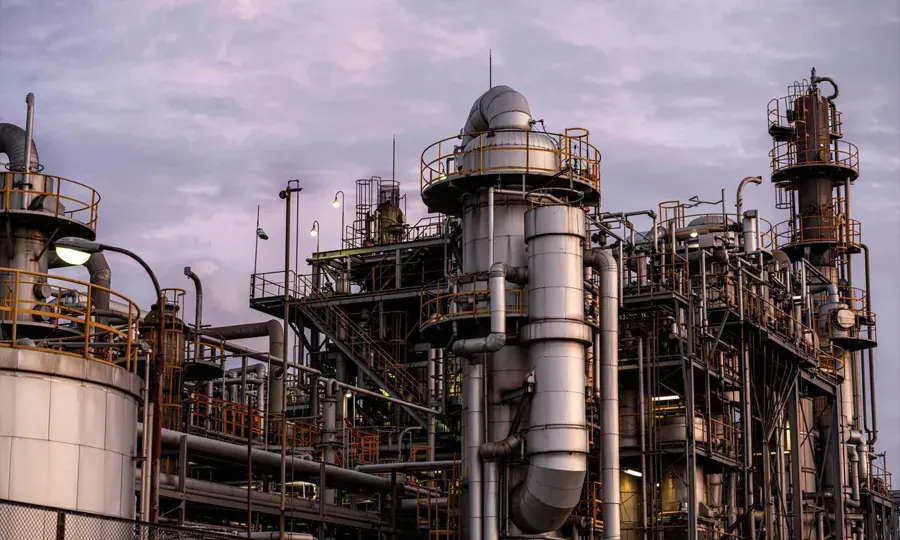 Petrochemical & ChemicalReactors, agitators, decanters and transfer pumps
 HVAC & Temperature ControlChillers, cooling towers, air handling and district systems