

Industry selection guide
VFD for Refrigeration & Cold Chain
A cold store is a continuous process whose product is temperature. This guide sets out what a variable frequency drive (VFD) has to do to keep that temperature stable without running the plant flat out all year.
How this industry uses a drive
Refrigeration is unusual among the industries in this guide because the load never stops. A cold store removes heat continuously, and the plant is designed for the hottest day of the year plus a margin, which means it runs well below its capacity for most of the year. Anything that lets the plant match its output to the actual heat gain — literally — is worth more here than anywhere else.
There is also a hard constraint that other industries do not have: the evaporating temperature. Running a compressor or a condenser pump slower reduces power, but if the evaporating temperature rises too far the product warms. Every saving has to be taken inside a band defined by food safety or process quality, and the control loop that keeps the plant at the slow end of that band is where the value sits.

Condenser and cooling-water control
On the condensing side, the relationship between flow, water temperature and compressor power is well understood, and it is the clearest saving available in a refrigeration plant. Cooling the condenser water more than the compressor needs costs pump and tower fan power; cooling it less than the compressor needs costs compressor power far more steeply. The optimum point moves as the wet-bulb changes, and a drive on the pumps and fans is what allows the plant to sit on it.
An evaporative condenser with integrated fans and spray pumps is the compact version of the same idea, and it is the machine most often converted in practice. The control has to sequence fan, spray pump and, where fitted, a water-treatment pump, and it has to do so with the ambient conditions as an input rather than with a fixed schedule. Done well, the plant stops fighting itself in spring and autumn.
Where the plant has a permanent-magnet synchronous motor on the cooling-water pump, there is a second saving available: permanent-magnet machines hold their efficiency much further down the speed range than induction motors, so the whole curve shifts rather than a single operating point. That is why the conversion is often done as part of a motor replacement rather than on its own.
Low temperature, high humidity, long hours
The physical conditions of a cold store are hostile in a way that a boiler house is not. Warm, humid air meets a cold surface somewhere in the plant, which means condensation and then ice. A drive installed in a plant room that is periodically washed down needs an enclosure rating chosen for that, and its cooling path has to reject heat without pulling wet air through the electronics.
Equipment in a freezer or a blast chiller faces the opposite problem: starting a motor that has been cold-soaked for hours, with lubricant that has thickened and clearances that have closed up. Starting torque is higher and the drive has to be able to deliver it without cooking the motor, which in practice means a torque boost at low speed and a current limit that protects the winding rather than the drive.
Long operating hours also make condition monitoring more valuable than in a plant that stops at weekends. Recording bearing-temperature trends, motor current at a known load point, or the time taken to pull down after a door opening turns a drive into a diagnostic instrument. On a cold store with a hundred thousand euros of stock inside, the ability to see a compressor degrading over weeks rather than failing on a Sunday night is a genuine business case.
Harmonics, filters and the shared network
A refrigeration plant is often the largest single electrical load in a distribution centre, and it runs continuously. A diode front end on a drive that size contributes distortion to the whole site, so the choice of rectifier is a site-level decision rather than a drive-level one. Active front ends and low-harmonic filters are the usual answers where the supply is weak or the site has a power quality target.
An active front end also makes the drive four-quadrant, which matters where the plant has significant regeneration — a condenser fan on a cold, windy day, or a compressor unloading. Rather than burning that energy in a resistor, a regenerative front end returns it to the network, which on a continuously running plant is measurable rather than theoretical.
The practical point is one of sequencing. The drive's rectifier, its input filter and the panel's cooling all interact, and the panel has to be laid out for all three at design stage. Adding a filter to an existing panel is often possible, but the space and the thermal calculation have to be done first.
Machinery typically driven
- Evaporative condensers and integrated units
- Cooling-water circulation pumps
- Condenser and tower fans
- Screw and reciprocating compressors
- Cold-store air coolers and unit coolers
- Blast freezers and chillers
- Brine and glycol circulation pumps
- Refrigerated warehouse ventilation
Selection rules to apply
- Quantify the allowable evaporating-temperature band first; every saving has to be taken inside it.
- Control the condensing side on approach temperature rather than a fixed flow, and expect the pumps and fans to run much of the year at part speed.
- Choose the enclosure for wash-down and condensation, and check the cooling path does not import wet air.
- Where the drive starts a cold-soaked motor, verify the low-speed torque boost is available before the load is applied.
- Decide the rectifier type from the site's harmonic limit, and lay the panel out for the filter at design stage.
- Record pull-down times and running currents as baselines so condition monitoring has something to compare against.
Series to start from
Confirm the rated current against your motor's full-load current before fixing the model; the frame size follows the overload the machine needs, not the motor nameplate alone.
- Screw-chiller VFD cabinet
- YD580
- YD287
- YD3000N
- YD3000N-CCS
Delivered projects in this industry
2 project records from this industry, with the plant, the motor and the measured result.
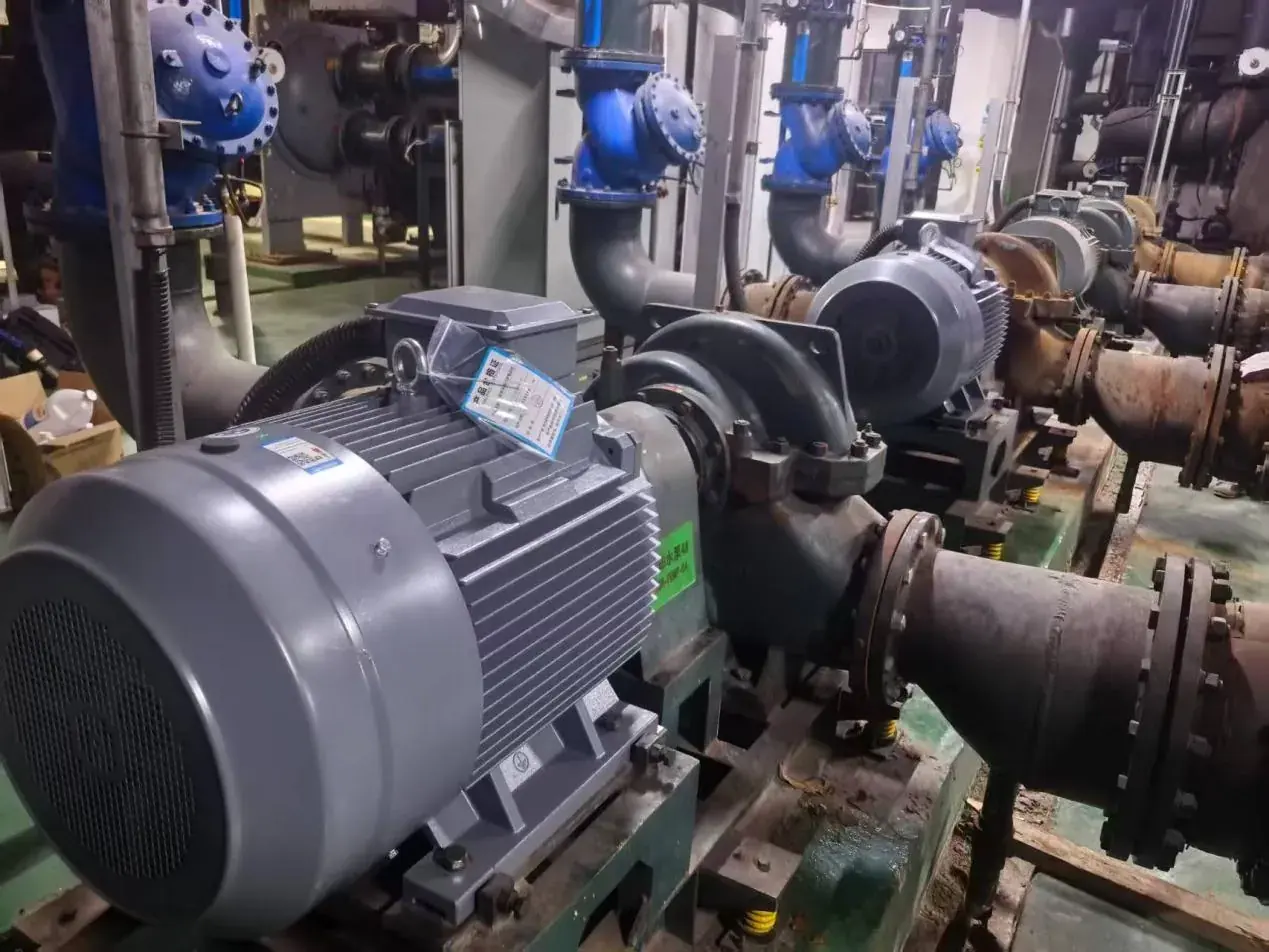 Cooling Water Pump Retrofit with a Permanent-Magnet Motor in ZhangjiagangZhangjiagang, Suzhou, China · 2026-01-16A cooling water pump driving an industrial chiller was converted to a 75 kW permanent-magnet motor on a 150 A YZJ580E drive, with local/remote control from the panel door and run and fault signals back to the plant PLC.
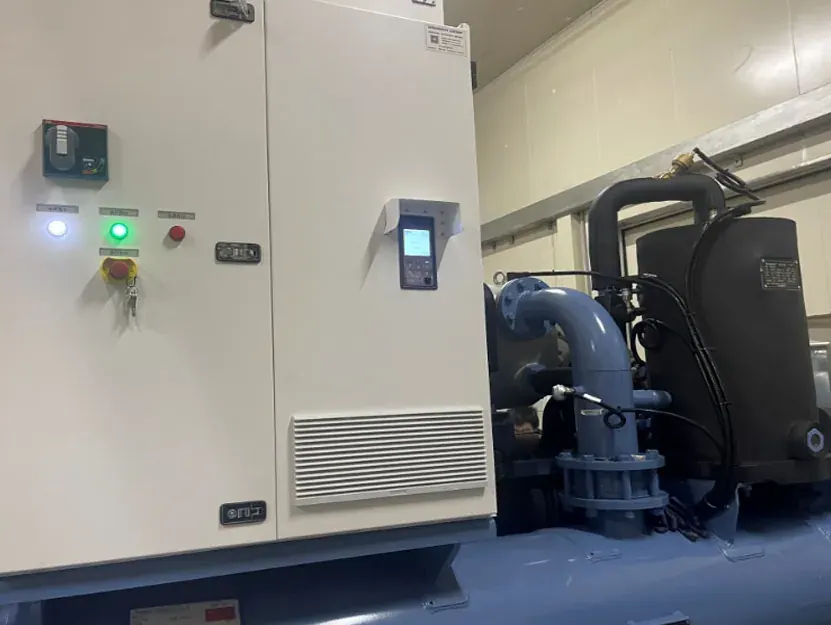 Evaporative-Condenser Chiller Unit: A Liquid-Cooled Drive for a Magnetic-Levitation CompressorPackaged chiller unit, China · 2025-03-22A water-cooled packaged chiller needed a drive that could sit inside the machine and keep a magnetic-levitation compressor stable at every duty point, without the airborne dust a forced-ventilation panel would pull in.
Related downloads
Manuals, brochures and selection guides for the series recommended above are in the download library.
Other industries
 Mining & Mineral ProcessingHoists, conveyors, mills and dewatering on a mine site
 Steelmaking & MetallurgyRolling mills, converters, conveyors and hydraulic power units
 Cranes & HoistingHoist, trolley and travel motions on cranes and lifts
 Oil & Gas ExtractionPumping units, linear motors and field power
 Petrochemical & ChemicalReactors, agitators, decanters and transfer pumps
 Fluid Power & WaterSupply, drainage, treatment and industrial fluid systems