

Industry selection guide
VFD for General Industry & OEM
Not every machine belongs to a named industry. This guide covers the standard-duty work that makes up most of the installed base, and the variable frequency drive (VFD) specification decisions that keep it reliable.
How this industry uses a drive
Most drives sold are sold into machines that no one would call a sector. A bagging machine for mushroom substrate, a small extruder, a workshop fan, a water chiller for a workshop, an agricultural conveyor. Each of them is a single application with its own small set of requirements, and none of them justifies a bespoke control design.
That is precisely why this category deserves a guide rather than being left as an afterthought. Standard-duty work is where drives are most often mis-specified, because the temptation is to buy on power and price and then discover the requirement that was missed. The requirements that get missed are almost always the same three: the starting torque the machine actually needs, the environment the drive will sit in, and whether the load regenerates.

The three requirements that get missed
The first is starting torque, and it is missed because the machine's nameplate gives a power figure and nothing else. A screw conveyor, a positive-displacement pump, a mixer in a settled tank and a loaded conveyor all demand more than 150 % of rated torque to break away from rest, and a general-purpose drive selected on motor kW may be a light-duty frame that cannot supply it. The published overload figure — 110 % for a light-duty frame, 150 % for heavy duty, 180 % or more for a specialist one — is the number that decides the order, and it is printed in the datasheet rather than implied by the power rating.
The second is the environment. A drive in a clean workshop at 30 °C and the same drive in a dusty mill at 45 °C are two different specifications, and the difference is the derating curve. Enclosure rating follows the same logic: a standard IP20 drive in the open air is fine in a control room and unacceptable in a wash-down area, where the answer may be a sealed cabinet, a higher-rated drive, or simply a different mounting position.
The third is regeneration. It catches out the applications nobody thinks of as regenerative: a conveyor with a decline, a fan that is being turned by the wind, a vertical axis releasing a load. In each case the drive sees power coming back and, with no path for it, trips on overvoltage. A braking resistor is the cheap answer where the energy is small and occasional; a regenerative front end is the right one where it is continuous.
Working with machine builders
A significant part of standard-duty work is supplying drives to machine builders rather than to end users, and that changes the specification entirely. The builder cares about the panel footprint, the wiring time, the availability of the same drive model over a production run of several years, and whether the drive can be configured from the machine's own controller instead of by hand.
The practical implication is that the catalogue numbers must not change. A machine builder who has spent a week commissioning a parameter set does not want to repeat it because a drive has been superseded, and an OEM relationship survives or dies on that point. Where a model does have to change, the offer has to include the migration path and a parameter converter, and it has to arrive well before the builder's next production batch rather than with it.
Documentation is the second half of that relationship. A builder needs the parameter list, the terminal assignments and the fault codes in a form that can go into their own manual, and they need them in the language their engineers work in. An OEM order that arrives without a documentation pack generates support calls for years, and each one costs more than the margin on the drive.
Keeping the installed base running
The machines in this category are often old, and the drives on them are older. When one fails, the site's real requirement is not the newest model but the fastest return to production, which means the replacement has to fit the existing panel, accept the existing control wiring and be configurable by whoever is available. That is a service question dressed up as a product one, and it is worth establishing the answer before the failure rather than during it.
Keeping a small stock of the sizes that repeat across a site is the cheapest form of insurance available, and identifying which sizes those are is a half-day exercise. Sites that do it recover from a failure in hours; sites that do not spend the same hours searching for a distributor with stock, and often end up with a different model that then needs its own commissioning.
The final point is record keeping. A site that knows which drive is on which machine, when it was installed and what its parameters were can replace it in a fraction of the time. That record also happens to be exactly what is needed to modernise the machine later, which is why it repays the effort twice.
Machinery typically driven
- Bagging, filling and sealing machines
- Screw conveyors and feeders
- Mixers, agitators and blenders
- Centrifuges and separators
- Workshop and process ventilation
- Small extruders and granulators
- Agricultural and food processing equipment
- Water chillers and small pumping sets
Selection rules to apply
- Check the overload figure against the machine's real breakaway torque before looking at the power rating.
- Confirm the ambient and the enclosure for the installation position, and apply the derating curve.
- Ask explicitly whether the load can be driven by gravity, wind or a falling mass, and provide a braking path if it can.
- For OEM orders, confirm catalogue continuity in writing and include a documentation pack in the builder's language.
- Keep a documented stock of the sizes that repeat across the site, with their parameter sets on file.
- Record the drive model, install date and parameters on every machine so the next replacement is a swap rather than a project.
Series to start from
Confirm the rated current against your motor's full-load current before fixing the model; the frame size follows the overload the machine needs, not the motor nameplate alone.
- YD580
- YD580E
- YD101
- YD201
- YD287
Delivered projects in this industry
2 project records from this industry, with the plant, the motor and the measured result.
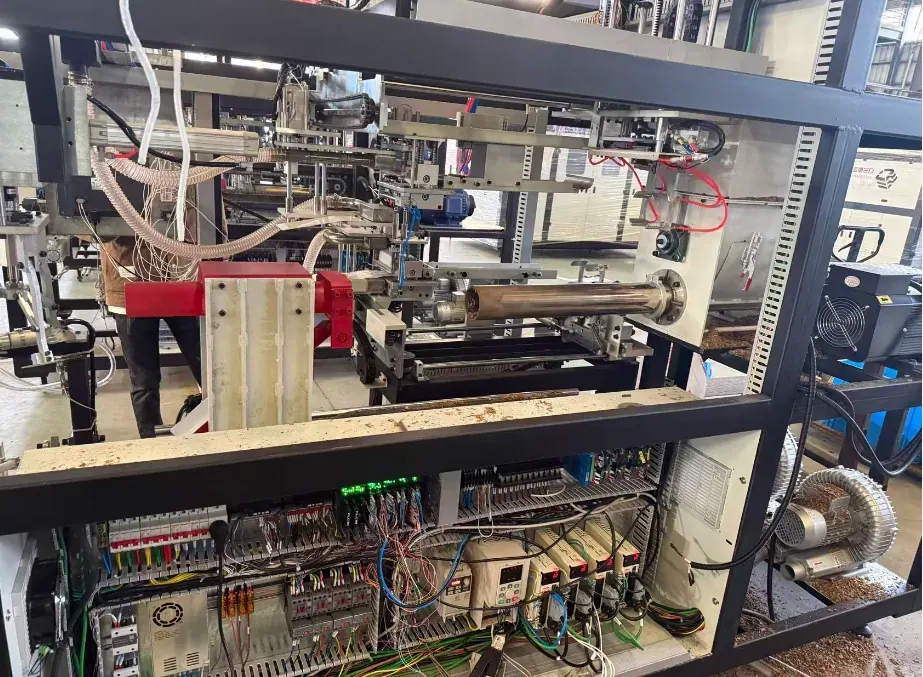 Mushroom Substrate Bagging Machine: Sizing a Drive for Hard Accel and DecelFuzhou, Fujian, China · 2025-12-26A substrate bagger weighs out each bag by counting turns of an auger. The motor reverses constantly and has to accelerate in 0.30 s and stop in 0.10 s, so the 7.5 kW motor is paired with a 25 A drive.
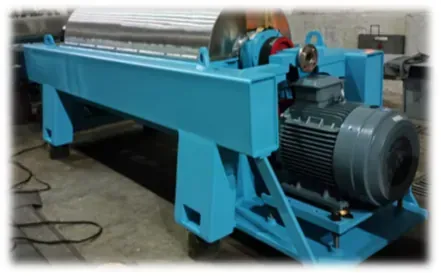 Decanter Centrifuge Drives on a Shared DC Bus: Recovering the Scroll's Regenerated EnergyWastewater treatment plants, Asia-Pacific and Africa · 2025-08-11A decanter runs a bowl motor and a scroll motor at slightly different speeds; the scroll is pushed backwards and regenerates. Wiring the two YD580 drives to one DC bus puts that energy back into the bowl instead of burning it in a resistor.
Related downloads
Manuals, brochures and selection guides for the series recommended above are in the download library.
Other industries
 Mining & Mineral ProcessingHoists, conveyors, mills and dewatering on a mine site
 Steelmaking & MetallurgyRolling mills, converters, conveyors and hydraulic power units
 Cranes & HoistingHoist, trolley and travel motions on cranes and lifts
 Oil & Gas ExtractionPumping units, linear motors and field power
 Petrochemical & ChemicalReactors, agitators, decanters and transfer pumps
 Fluid Power & WaterSupply, drainage, treatment and industrial fluid systems